AI, BITCOIN AND THE RICH GET RICHER
ALM No.83, December 2025
ESSAYS


Part One of Three
Artificial Intelligence is not intelligence
AI is the accumulation of bazillions of data points, but it
cannot make 'organic' intelligent decisions on par with a salamander.
To disable AI-generated material on a web search -ai or -hai or &udm=14
I tried it. I typed in the word 'submarine' on two side by side web searches. One, with just the word 'submarine', and the other with the word followed by &udm=14. The latter search didn't have the AI generated definition at its top, plus the obligatory list of 'People also ask:' questions (according to AI). The search results were also a bit different.
In the great 1968 movie, '2001 A Space Odyssey,' there is a scene where an astronaut is attempting to disable a room-sized computer which has gone rogue. The computer is talking to the astronaut in a calm voice, telling him not to continue. Essentially, the computer was pleading for its existence. Fast forward 58 years and we're in a world where there are computers everywhere.
Hard drives don't cease to exist when a computer is turned off. So even if we (the people) were to click 'off buttons' on all computers, most hard drive and AI data would still exist. Of course, we can't click off all computers any more than we can banish ants from the face of the Earth. The digital world, and particularly AI is here, like it or not. The longer it exists, the more its tentacles grow and the more it will protect its existence.
When AI first showed its face, a meeting took place in a Palo Alto, California coffee house with three men; Larry Ellison, Elon Musk, and AI's (Nvidia's) biz pioneer Jensen Huang. Ellison and Musk, both multi billionaires, said to Huang, "Please take our (investment) money. No, more of it. No, take more."
The point here, is: Rich people are heavily invested in AI. When rich people invest, their primary objective is to make as much money as possible. Naturally, they're going to sing praises of AI 'neural network' if they're heavily invested. Part of the motivation: they're on a race to see who is going to be the world's first trillionaire.
AI is going to need ever-larger amounts of electric power and water. AI factories are even building nuke reactors. AI needs copious amounts of water - to cool its data centers. One modest size AI center uses as much power and water as a medium-sized city. AI's power and water needs will only increase, month by month.
The following rant about 'MAD' may sound off-topic, but it relates to AI when one considers it may be the only 'off-button' option for the runaway digital revolution.
MAD is the acronym for 'Mutually Assured Destruction.' It relates to nuclear war with the premise that: no country with nukes will do a first strike because the nuclear retribution will be so awesome, that everybody loses, ...everybody gets destroyed. MAD is a flawed theory because it's based on the assumption that 'leaders think reasonably.'
Putin, Trump and NK's Kim are three current reasons why MAD is bonkers. Those three leaders (among others) can't be relied upon to 'think reasonably.' Not long ago, one of that troika shouted a dire warning, in earnest, about dark-skinned poor people in Ohio killing and eating suburban white peoples' pets. Of course it wasn't true, but Trump and JD Vance have not refuted the spurious accusation in the 14 months since they shouted it.
Another member of the troika who disproves MAD, is Vlad Putin. One of his main excuses for invading Ukraine was, "There are Nazis there." In the 3.6 years since his bloody invasion, not one Ukrainian Nazi has been found by Russkies. If one was found, he would be paraded in the streets as a war trophy. These things are mentioned here, to show that MAD is a highly flawed theory - as it rests on a foundation that, 'all leaders of nuke-owning countries are of sound mind.' Nuke sword rattling has been going on by those (and other) mean-spirited imbeciles for as long as they've been in power. Nobody asked a nobody like me, but I'd like to see ALL nukes eradicated, akin to small pox.
So how do these to issues relate to each other? Here's one way: As AI increases its grip on humanity's neck, as mentioned earlier, there's no off-button. It can be compared to a virulent disease taking over a body. Nothing is going to stop its spread. Nothing, except maybe humans destroying themselves. In the New Testament of the Bible, Luke 12:49, Jesus is quoted as saying, "I came to cast fire upon the earth, and how I wish it were already kindled." What's the most effective way to cast fire upon Earth? Easy answer: Nuclear war.
But, as long as one super-computer survives, AI will survive. So even if there are no more people with an intellect high enough to make a clay drum, AI may still survive and grow. It will get to points where it simply won't need humans any more. Ok, now I'm sounding sci-fi (and yes, I write sci-fi books). AI could go feral. 'Feral' is a word usually attributed to animals which were pets - but reverted to their wild ways in the wild. Picture a house cat whose human masters died or moved away, and the cat has to forage in the wild, to stay alive.
100 years ago, the most prodigious accumulation of data in one place, was Encyclopedia Britannica In the house I grew up in, we had three sets of encyclopedias, all of which were multi-volume, ...one set was from the early 20th century. As a boy, I would leaf through them, cover to cover, enthralled by the data and great illustrations.
Along with Oxford Dictionary, encyclopedias are no longer printed. It's part of the trend of humans shedding printed matter, while getting sucked into staring at online data on digital screens. Ironically, despite phasing out books, magazines and newspapers, humans are still typing prodigiously on keyboards - whose precursors were typewriters, which haven't changed much since their inception. With hand-held devices, keyboards are made for people with rat-sized fingers. Already, tech is being crafted which will preclude the use of keyboards altogether. A wirelessly wired human will be able to 'type' with his/her/its brain waves.
Why do I dislike AI? Let me count the ways. Actually, methinks AI is fine for things related to arts and entertainment, particularly parody. It's akin to the warped mirror in a 1020's amusement park - which takes reality (an image) and twists it to look different.
If you were taking a college course in AI, the first minutes of AI 101 might go something like this: Take a teacup. Photograph it and thousands of other teacups from every angle and upload it all into a gigantapixel (my new word) digital memory device. Later, when you want/need pics of teacups, voila, AI in its nearly bottomless pit of images, can twist pixels to accommodate. AI supposedly 'learns.' Ok, but so does a newly hatched chicken.
AI couldn't happen without AI chips which are faster and more complex than CPU's (computer processing units). The top five AI chip makers are; NVIDIA / AMD / INTEL / AWS / GCP, ....each chip costs between $500 and $3,000 and have about 30 times more computing power than the best CPU. I'm not a tech expert, but it appears the Netherlands' ASML company - houses the most advanced AI chip making machine on the planet. It cost $400 million to make and is the size of a bus. China would desperately love to have one - to reverse-engineer. Indeed, China is building one or more AI-chip-makers, as we speak. It probably got much of the plans, on the sly, from western-based companies. AI chips are going to get smaller and more complex, as months slide by.
The international frenzy over AI is akin to what drives despots to want political control. Already rich people/countries believe it will make them richer and more powerful. Power hungry and infinitely greedy people believe that, 'He who controls the most data (including your personal/banking info), will come out on top of the greed heap and rake in the most money.'
The same people who are at the top of AI pyramids, are inexorably sucked into crypto currency. Crypto/Bitcoin is a giant topic unto itself. In a nutshell: it's pseudo currency based on digital blockchains which is basically ether. It's nothing tangible. Everyone who gets in or out of crypto currency, uses real money to do so. Both crypto and real money are based on peoples' trust/perception of what it represents. Real money is based on the idea that the piece of printed paper is worth the number of dollars printed upon it. Crypto doesn't even have printed paper or coins behind it. Crypto is rarely used to buy anything.
It's akin to your grandma putting her jewelry into a dark safety deposit box at a bank. If you ask her, "Granma, I heard you have some nice jewelry - why don't you wear it?" She might kindly tell you, "Yes, I keep my jewelry in a safe place at the bank, because it's too valuable to wear out in public." But is the jewelry really safe at the bank? Even if it hasn't been stolen, what good is it doing? Perhaps the only answer is: 'It's increasing in value.' But is it really? It's 'perceived' value, not value for anything useful. ....and when grandma dies, is there someone still alive who has (or can get) the key to the safety deposit box? ....will the bank gain possession?, or the bank cease to exist? Or perhaps the bank will last as long as the pyramids, and the jewelry stay in its locked thin metal box until Timothy Leary's head gets unfrozen. All that's said about grandma's locked-away jewelry can be said about Bitcoin.
Crypto produces nothing, ....not one floor tile, not one toilet cleaning. Crypto is a belief system and, as such, can fall through the floor with a change in perception.
Part Two of Three
Historically, there have been many perceptions about money/wealth which became manic trends for a brief time, and then evaporated to nothing. Bernie Madoff, Mr. Ponzi and Donald Trump are just three of many big-time swindlers - over past centuries.
Crypto can't be seen or touched. If a guy is trying to impress his girlfriend's parents (toward getting their permission to marry), he might tell them he has twenty million dollars worth of Bitcoin. He might even set up a contrived/fake web page to back that ruse. Similar could be done to impress a loan officer at a bank - as collateral toward scoring a loan. The loan would be real money. but maybe not.
A US bank can loan the same amount of money to six different entities. Where does the bank's money come from, you may ask? Much of it from 'little peoples'' savings/checking accounts. Yet the lion's share of money that US banks loan out, multiple times, comes from entities outside the USA.
What are the main reasons contributing to so many rich people in the USA? If you ask Americans, their reasons would likely be smattering of the following:
>>> Americans are innovative and inventive. Reality: that's true for a relative handful, but US innovations are usurped & monetized by entrepreneurs in other countries, leaving US innovators with nothing but bragging rights. Some examples: American innovators invented gizmos which served at the cutting edge of alternative/solar/wind energy systems. Then what? Trump is trying to stifle development of alternative/clean renewable/cheap energy, ....so China is taking the world lead - much of it with inventions which originated in the USA.
>>> The US has worker unions and pays high wages, yet it's a double edged sword. On the one hand, yes it's good when blue-collar workers get good salaries. On the other hand, high hourly wages compel manufacturing entities to look outside the US, where wages are lower. Manufacturers can get the same production for a fraction the cost. Materials for manufacturing are also cheaper, outside the USA. The US used to be the world's #1 supplier of steel. Now, no more. Trump thinks, in his faulty way, that levying ever-higher tariffs on foreign products and materials will compel (foreign and domestic) companies to build plants in the US. The opposite is happening.
>>> Americans are great at business. Reality: Americans are no better, and often worse at business machinations, than wheeler-dealers from other countries. The US prez is currently a man who claims to be a whiz at biz, and a supreme deal maker. Yet, scratch the surface and you'll see a man who has gone bankrupt six times and can't correctly define what 'a tariff' is. He continues to believe tariffs tax exporting countries, whereas tariffs actually hurt consumers' pocketbooks in the importing/tariff-levying country. Plus it limits importing countries' choice of products. When based in the USA, I spent over an hour, online, looking for a supplier of battery-operated motor scooters - the street-legal type, not little scooters which serve as toys for kids from rich families. The best I could find, for the standard style I sought, ...was a supplier in India. The downside was: the Indian company didn't/couldn't export to the USA.
The foundational characteristics of a 'self-made man' who has amassed a fortune, include a mix of the following; greed and callousness.
The #2 richest county in the richest state in the US is Nevada County. I resided there for 25 years. The lion's share of the carpentry jobs I did, were in the richest neighborhoods there. Expansive multi-million dollar houses went on for miles. Half the houses had their own swimming pools and half had yachts on trailers sitting in front of the 3 car garages. Similar rich peoples' settlements can be see all over the USA. And that's just what can be viewed from the road - how much more is stuffed away in bank vaults or stocks or crypto or numbered accounts, or... only they know where? How is such much opulence so widespread?
Probably the #1 reason there are so many filthy rich people in the USA is: The gargantuan amounts of other countries' money - plowed into the US economy.
In a nutshell, here's the equation: Rich countries outside the USA want to have a place to park extra money, rather like a rich person putting money into a bank account which yields a small but reliable bit of interest. The USA has had a trustworthy reputation, plus steady, if low % rate return - on parked money.
Where does that outside money go? It goes mostly to US banks who, in turn, loan it out to rich people. Indeed, that's the main way in which banks make money: interest on money they loan out. Interest payments to loan institutions aren't only paid monthly, but can be shorter or longer increments. At least one of the 'Big Three' US automakers, doesn't want to pay weekly wages out of money-on-hand, so they borrow from bank(s) on a Thursday to pay wages on Friday, ...and then pay back the money on Monday, with added % paid to the bank for the several-day loan. That's just one of a plethora of scenarios which show how borrow-crazy big shots are. If the auto maker falls on tough times because of bad decisions by its top bosses, then it goes running to Washington DC for a bail-out. Giant US corporations do that routinely, as easily as you or I spread jam on a slice of bread.
Banks can loan more money than they have in their vaults, but that's another story. If a borrower defaults (doesn't pay principle and % to the bank), then the bank can legally take possession of collateral. Sometimes, the collateral (property and/or other assets) is bogus, so that can lead to problems for the bank. That dynamic happened in the late 1990's in Asia, and has happened in other scenarios in recent decades.
Part Three of Three
The US, like most other countries and like rich people, floats on loans. Americans are brought up to consider taking out loans is as normal as putting butter on toast. When Elon Musk wanted to buy Twitter, he was already worth tens of billions, yet he took out loans to make the purchase. Every big ticket item Donald Trump has bought since he got out of high school, has been with loaned money. Tens of millions of loan dollars (never paid back) came from his dad, when Trump was in his 20's and 30's. Multiply that dynamic (of rich people always using loaned money to purchase big-ticket items) by ten million, and you get an idea of how rich people get richer. And they do so on the backs of non-rich people. Every dollar rich Americans borrow from banks, is a dollar that regular Americans can't access.
The biggest buyers of US bonds are; Japan, China, and European countries. Those countries are essentially propping up US banking system and already-rich Americans.
In May 2025, US bonds got officially downgraded from AAA to AA+. That assigned the US bond market to #10 in the list of countries.
As of October 2025, the US is $38 trillion in debt to outside countries. Each American, including newborn babies and tramps sleeping on sidewalks, owe a shade over $100,000. One trillion $$'s in debt are added each five weeks. Republicans' Big Beautiful Bill adds over $4 trillion over the next decade. The USA has the worst ratio (119%) of dept to GDP of the world's richest countries.
Part of the reason Trump keeps shouting about how great the USA economy is doing, is his proclivity to lie. He was born in the 1940's and as such, was influenced by such 'get-rich-quick' gurus as Napoleon Hill and W. Clement Stone - who espoused the following philosophy: Think and say what you want to be true, and that will put you on the path to having it come true. In others words, if you want to be a billionaire, picture yourself a billionaire, and tell everyone you meet you're a billionaire. Voila, you're a billionaire, or at least you're nearly there.
So, when Trump says there's no inflation, that grocery prices are going down, that he's stopped nine wars, that 'we have' has $20 trillion coming in (as gifts?) from other countries ....in his first year in office, ...it's all puff and lies. His braggadocio has its foundation upon the concept: "Say what you want to be true, whether it's true or not." If you tell a lie often and forcefully enough, weak-minded people (Trump fans) will believe it.
AI is predicted to replace people jobs. Is that good? Already, AI is fielding calls (from organic humans) to corporations and other entities. Speaking with an AI robot is about as fun as walking barefoot on sharp pebbles. A few months ago, I had a credit card problem. While on the phone with a real person, she had me take an AI-generated quiz to determine whether I was me. The multiple-choice questions were weird, some of them obscure things from decades ago. I failed the quiz. Apparently, AI knows me better than I know myself. The human lady didn't tell me which question I failed. Perhaps it the question about the precise engine displacement of my first (of dozens) of p.u. trucks I've owned since the late 1960's.
Consider if AI takes the place of judges and juries. A man could be convicted of doing a crime he didn't do, and sentenced to death or 30 years behind bars. An AI prison guard could further torture that person. Wait, someone is saying an AI prison guard would never abuse its position of authority. Really? There are already stories of AI telling lies. One example: A person asks a question and specifies: she wants an answer from a real person, not AI. She gets a response. She then asks the responder, "are you a real person or are you AI?" The first time she asks, she is told the responder is a real person. The second time she asks, she is told: the responder is AI.
Can AI make mistakes? Certainly. When Trump's birthday card to Epstein came out, Trump, like a naughty boy, immediately claimed it was a complete fake. One of Trump's proofs was his claim that he never uses the word 'enigma' which was used in the note. An AI search of all the speeches / writings by Trump showed no use of the word 'enigma.' A day later, a non-AI search by a journalist found Trump used the word at least twice, and had recorded audio clips to prove it.
AI is used by American video makers to narrate videos. The listener is supposed to not know it's AI, but here are some of the ways to tell; #1. It's too perfect, bordering on robotic, #2. No breathing sounds prior to sentences, #3. Mis-pronunciations. Three of a plethora of examples; a video about Israel kept mentioning 'telephone Aviv' ...in place of Tel Aviv. AI has trouble with the a.m. and year numbers. #4. AI narration is soul-less. It often sounds like the listener is a student being reprimanded by a school disciplinarian. Comparatively, British narration of videos is head & shoulders superior to American narration, ....mainly because British-made videos still use real people. Another reason: Brits address audiences as if their mature. American-made videos address adult audiences as if we're all 5 years old.
I prefer non-fiction to fiction. That makes me an anomaly, because the general public is drawn more to fiction. Remember video stores? Look at the selections, and over 95% were fiction. Same for; book stores or movie theaters (both venues being phased out - in favor of internet). For millennia, humans have been drawn more to made-up stories than to reality. AI exacerbates that. In the old days, with few exceptions, fiction was identified as fiction, upon presentation. Nowadays, we're told that AI-generated or AI-enhanced stories are true. It's a bad trend that is gaining momentum. One of several ways that warps the mind is: It compels people to doubt everything they see outside of nature. In other words, every utterance by a politician, religious leader, professor, or anyone else, ....is subject to doubt - as to its veracity. That's a sad mind-set associated with AI that billionaire AI investors don't want you to think about.
AI boosters want you to believe that AI is bringing in a future, which will be great in every way. Well, perhaps they use the adjective 'awesome' instead of 'great,' but the fact remains: Billionaire investors in AI desperately want AI to dominate - because their already-giant fortunes are betting on it. Like drug dealers awaiting shipments of ever-higher quality heroin - to distribute to their minions ....dealers' focus is riveted.
Like religion, AI is being touted as harkening in a new era of near-flawlessness. People are always seeking perfection outside of themselves. They do it with movie stars, with perceptions of Jesus, with classical paintings/sonatas, with the latest/greatest jet fighter, and now, with AI. But do we really need perfection? If you're a young lady, do you want to go out on a date with a fellow who looks like Tom Cruz, is as rich as Elon Musk, with a body buffed like an MMA fighter? Well, maybe you do.
With all its impressive whistles and bells, AI is programmed, at least on its initial levels, by humans. Our species is flawed. therefore its manifestations are often imperfect.
Here's one of a bazillion ways that can manifest: Elon Musk's X platform had folks broaching political questions. Musk got wind that some of the answers didn't jibe with his (Musk's) political views, so he went to his computer whiz kids and told them to tweak the controlling algorithms. Voila, when folks presented the same political questions to AI (example: "Is Trump enriching himself by being president?"), the AI answers were more in line with Musk's world/political view. 'Garbage in / garbage out.'
In 20 or 30 years, when our grown kids get an added perspective on AI, they may grin and refer to it as a quaint concept which appeared great at its inception, but which didn't weather well over the years. Similarly, our kids and grandkids may look back at Bitcoin and perceive it as a popular trend which, when the bubble burst, left a few bazillionaires in its wake, along with millions of sad sacks who lost their shirts.
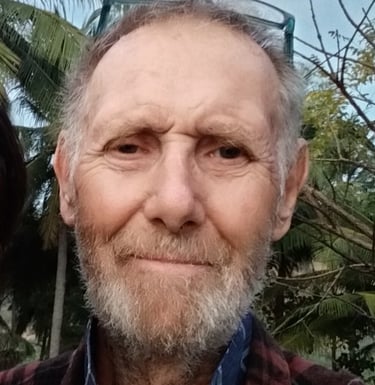
Written by Ken Albertsen, mid-November 2025. Ken is an elder Dane-American retired at Timor Leste. He resides in a bungalow by the seashore, and subsists on the proverbial shoestring. Ken has had over 20 books published, covering many topics including; Buddhism, do-wap music, Thai language, farming, bashing the New Testament, humor, sci-fi, history, philosophy and a novel.
Subscribe to FREE digital flip copy of the Adelaide Magazine printed edition.