FEATURES OF A CHILD’S LIFE
ALM No.86, February 2026
ESSAYS


To be mature in an early age has an ambivalent connotation! Circumstances may mould you this way, and it can be very resourceful and beneficial in your lifetime. It will enhance your sight; and maybe, your foresight! It can even save you from risky situations and lift you up, and make you avoid dangerous people and environment! You will be far ahead of your peers and associates in life experience. This means that you can easily estimate the danger; while they will not even sense it!
What makes you mature in an early age? This is a tricky question to ask; but it is vital to decode it. This can help enlighten people about the possibilities in life—maybe the fantastical or unbelievable ones! It can open up untrodden routes in the associates’ minds. It can alert them that life is not always sweet—there is bitterness somewhere and sometime. Let us go back to our question—what makes someone mature in an early age? I think on an individual level, it is a combination of many things—your upbringing, what influenced your upbringing, where you asked to do things that only adults could achieve?
Now, how to materialise this in childhood experiences? Let me tell you a few tough experiences for an eight-year old child. One of them is when my mother used to wake me up very early in the morning to go to the milk-woman in our neighbourhood. Although, there were other older siblings, but my mother always depended on me. This is because she believed in my abilities more than my other older siblings’.
It is something that always made me feel special and exceeding my peers, or even those who are a few years older than me. So, I would listen to my mother and, I would carry the milk bucket and walk down the lane in my village—it was a beautiful rural, narrow road; with small hedges on both sides. The hedges were made of stones of different sizes and shapes—basically rubble; but meshmashed with some dry branches or tweaks.
If you ask me what I was feeling, I would frankly say that I was thinking of Little Red Riding Hood—thinking that a wolf could appear suddenly and unexpectedly at any moment! The sun rose a bit later than my usual winter trip to Um Eidou, the milk-woman. This made me look over my shoulder to check if someone was tiptoeing me! Whenever I arrived to Um Eidou, I would let out a soft exhale —Horrraaaay! I made it!
There, Um Eidou would receive me with a shining smile, and would be welcoming me, saying: “May God make your morning merry!” Then, she would ask me to follow her to the animals’ shed—it was like a shack, as its rooftop was a piece of metal; adjacent to her house. She would enter the shack to bring out the cow to milk it. Most of the time, the cow would be reluctant to listen to Um Eidou, showing stubborn-ness; however, the milk-woman would curse the naughty cow, by saying: “May God curse you! You, may God burn you in Hell!” Those curses were mind-boggling to me the first couple of times; but later, I got used to the skirmishes between the cow and Um Eidou!
Anyway, I would follow her and her cow to a soil covered square, where Um Eidou would pitch a big nail on the ground to tie the cow to. Then, she would sit on a small wooden stool, nearly under the cow, and the rituals of milking would start. Um Eidou would touch the udder and milk it, repeating the words: “Hooo Haaa! Hooo Haaa!” Those words; or maybe incantations, were feats of magic—they definitely helped to stimulate the cow, letting the milk easily and smoothly gush off the udder into a big, black rubber bucket. The same thing would Um Eidou do with the other udder. Actually, she would keep repeating the same act and alternating between both udders, until the bucket is full. As soon Um Eidou finished milking the cow, she would pour milk from the big bucket into my bucket.
By so doing, I would walk back home, carrying my own Little Red Riding Hood basket—a bucket full of milk! Anxiety would come back to me on my walk back home—looking left and right till I arrive safely home! Upon my arrival, my mother would take the milk from me and put it on the cooker to boil. For five to ten minutes. This would help create a thick creamy top. Then, my mother would take off the creamy top and put it in a separate dish in the fridge to have it with honey for dinner.
For breakfast, my mother would serve us the boiled milk to dip ka’ak (breadstick baked with sesame and nigella seeds; and with specific spices, such as fnugreek, mahlabe, fennel and aniseed). My mother would also serve us a platter of different kinds of dry food, such as zeit w za’tar (olive oil and a mixture of roasted, dried and ground herbs, such as thyme, carob, watermelon seeds, melon seeds, sumac, sesame seeds), akkawi cheese, honey, samneh zibdeh (organic, home-made butter), green olives, black olives, makdous (boiled and strained aubergine, stuffed with finely chopped and dried walnut, red pepper and garlic; while all is immersed in a jar of olive oil). Of course, we would not swallow a bite without a sip of tea. Therefore, my mother would brew a big metal teapot (adding loose tea to cold water, and putting the blend on the stove to come to a boil)
Another childhood experience was when my mother used to recourse to me in key house chores. For instance, my mother would call me to help her in hanging the washing on the washing lines on the house rooftop. She would wash the clothes on the manual washing machine—having two rollers, connected to a crank to squeeze the water off the washed clothes. But the rituals start firs with asking me to buy her bareh saboun (dessicated white soap), dawa ghaseel (washing powder) and neileh (dark blue cubes that help keep the white colour of the white washing). Then, on elbabbour (an old device to cook or boil water on. It is copper, with three metal legs and a small hand on the side, which you push in and out to stimulate the gasoline to go upward. So, you can light it and see the flame on).
My mother would boil water mixed with the dessicated white soap and with washing powder. After that, she would add this boiled mix into the basin of the washing machine and let it on for a round or two to wash the clothes. Then, she would put the washing in the mangle and rotate the rollers with a crank. Then she would put the squeezed white washing into a basin full of water and the dissolved navy cube, which would prevent the white washing from going off white. Now, she would squeeze the white washing by her both hands, put them in a big basket. Then, she would ask me to take the basket to the house rooftop to hang the washing on the washing lines. Bearing in mind that I had older siblings—brothers and sisters. However, my mother always believed that I could do better than those who were older than me.
One day, I was studying at my friend’s house. Therefore, I could not help my mother with the washing rituals. However, when I came back home, I found my mother poorly and lying on bed. I asked my mother: “Why are you in bed?” She replied: “Because you were not here, I got ill. I was sweating; but still went to the house rooftop and hanged the washing on the washing lines. This immediately made me fall ill!” My mother became seriously ill because of me. I kept blaming myself for that. How could I cause this to my mother. It was very traumatic for me. It was beyond my comprehension or even imagination. I would see the doctor visiting to check on her. I would see her lying on bed an a foam was covering her mouth. I would hear the doctor saying that she was seriously ill and that she probably had a brain stroke. All this happened to my mother because of me! I was in deep sadness. This caused a lifelong scar. I kept blaming myself for what happened to my mother. I was nine years old then!
My father took my mother to the best hospital in Damascus. There, she stayed for more than a month, where the medical consultants intensively treated her —they rehabilitated her as she needs to re-learn speech and re-learn how to walk. When the consultants decided to discharge
her, they asked my father to take her to a quiet place, as noise will make her health deteriorate. Therefore, my father took my mother straight to her married sister, with no children, in Lattakia. There, my mother stayed for six months, away from her children.
Similarly, her children lived without their mother for almost eight months. During that stage, I experienced the emotional deprivation—how to feel without a mother. What does your life look like? Obviously, I, as child, needed the help of my eldest married sister to look after me—hygiene wise and health wise. My sister used to send her driver every Thursday evening to take me to her house, as the weekend in Syria then was on Fridays only. The driver would bring me back to my village every Friday evening, so I can go to school. Our neighbours were very kind and supportive to my siblings. They used to take turns in taking care of my siblings—giving them a shower, cooking for them and washing their clothes. Yes, this is what you call social and emotional solidarity, which we miss in this modern world.
I was very close to my mother. I easily could recall that whenever I came back from school, I would shout “Emmay!” Which means “mum!” And I would feel safe when I would hear her responding: “Eh Yamoui!” Which means “Yes, mum!” I was her secret keeper, her treasure guardian and her mini accountant! My mother brought expensive stuff from Yemen when she came back in 1972, the year I was born—expensive clothes and fabric, precious stones and unique shapes of golden necklaces. She used to keep them in a big suitcase under her beautiful royal beds.
My mother would ask me to lie down on my stomach and drag myself under her two king size beds to fetch the third big suitcase, which was the furthest. This demanded from me to lower my head, so I could avoid bumping my head against the flat wooden part of the beds, above my head. I considered myself swimming on a dry, mirror-like land, as our floor was marble. Anyway, I would drag the first suitcase, the second suitcase; and finally, I got hold of the third suitcase—I would drag it to my mother, who, in turn, would kneeling on her knees, bend forward take a bunch of keys off the corner of her bra—attached with an elastic band to her bra, she would choose the right small key to open the treasure suitcase.
Upon opening her treasure suitcase, she would ask me to count her reservoir of money, so she could know what would be left after asking me to count a certain sum to give to someone, without the knowledge of my father, or to pay for something she wanted to buy for herself. After that, I would take back the treasure suitcase to its place, after my mother locked it. My mother needed me as she was illiterate. Also, she would not trust my other siblings. This is why my mother was heavily dependent on me on a few things. This made me realise that I was more mature than my peers, more responsible than my siblings, and trustworthy.
My mother was not only believing in my mental and intelligent abilities; but, it seemed that she believed in my adventurous spirit as well; as one day, she gave me a bunch of cloves and a stone of pure kohl, which she brought with her from Yemen, and she asked me to go to my aunt Um Salim. I never visited Um Salim’s house. All I knew about Um Salim then was that she was my father’s aunt from his father’s side.
However, because my mother believed in me, she asked me to hand these stuff to my aunt, so she could make Kohl powder. My mother gave me two makhalah (a beautiful, silver and hand ornamented pot to reserve the kohl powder, and the top part is the metal pencil that works as an eye pencil—you dip this part in the makhalah pot and then apply it on the inner part of your eyelids). Anyway, when I asked my mother: “Where is my aunt’s house?” My mother replied: “It is near the house of the seamstress Jamilah.”
Of course, I blindly slistened to my mothr, and I started my walk to the first landmark, Jamilah’s house. I arrived to Jamilah’s house, where I asked her about the location of my Um Salim’s house. Jamilah left her place behind the sewing machine, and she came out. All the information that Jamilah gave me was signalling to go to the right.
I swerved to the right. The route was an amazing rural piece. It looked as if it had been taken from a cartoon film—different shapes and colours of butterflies on both sides of the green path, plants and insects I never saw before, aged trees, massive mulberry trees. The whole scenery was breathtaking—even the small and low greyish walls on both sides were skilful and artistically made, but in a nature-friendly way, where only raw material was used. No cement…only bits and pieces from nature itself were designed in a nice and symmetrical way, although the sizes of the stones were not the same. While walking, I noticed a big blue wooden door.
Finally, I reached the first house. I knocked the door to ask if they knew where Um Salim’s house is. To my surprise, Um Salim was the one who opened the door. She welcomed me, saying: “Ahleen ya Betty!” Which means “You, daughter, welcome!” I entered the house and sat down. Then, I gave her what my mother asked me to hand her. She took them and brewed tea for me. She kept praying, asking God to protect me from the evil eye, as she found me very beautiful and clever child and relative.
If you ask me how your experiences in your early childhood affected your life, I would give an example. I might have developed a very distinctive intuition that could sense danger. For instance, nobody ever told me that war would break in my country only a few months after me leaving the country.
However, there was something in me compelling me to leave Syria—unhappy in my marriage, dissatisfied with my x-husband’s behaviour, disappointed and let down by his family and my family. An escape plan started. This demanded me to study hard, prepare for the English Language Proficiency Test. Finding someone to sell my property, getting money that would be reasonably sufficient for as much a reasonable period of me staying in the foreign country.
All those preparations took their toll on me. I was almost exhausted; but optimistic about building a new life always pushed me forward. The most difficult bit was to convince my husband to give us official permission to leave the country. Thank God, all went well, with the mediation of the shared friends. Anyway, my gut was telling me to leave that country for almost two years, which was the time it took me to do all the travel or immigration preparations. The good thing was that although there were no signs of unrest or foredooming war, still my gut feeling kept telling me to leave that country. Fortunately, we left the country only six months before the start of the first signs of war.
Although my tough experiences keep haunting me, I do not want to dwell on more dangers I came across, as those risky situations were felt only by me in the first place. But, interestingly, my gut feeling always proved right. On one hand, this looked scary; but it is a natural gift, cultivated by my early childhood experiences on the other hand. It is not easy, and it is scary and incomprehensible for some people; but, reality sometimes is stranger than fiction.
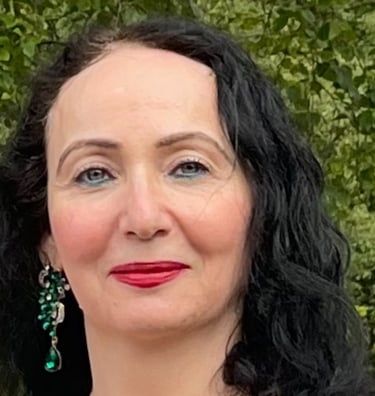
Huwaida Issa is the translator, who is also an emerging writer. She was born in Yemen and brought up in Syria. She is from an underrepresented category--an immigrant, a single mother and with a disability. Huwaida has been an interpreter for fourteen years. She published three academic articles and eight translated short stories and five translated poems.
Subscribe to FREE digital flip copy of the Adelaide Magazine printed edition.