HEAD DOWN, CAR ON THE SIDEWALK
ALM No.88, April 2026
ESSAYS
It was the summer after third grade. My mom had been excited for this summer; she’d spent the last several months arranging our first family trip to Hawaii. She’s the one who deals with money and planning in our household because my dad gets too stressed seeing numbers go up and down with every new paycheck and expense. He’s quite a realist, hyperaware of the economy and how important money is in this world, leaving him unceasingly worried about the coming and going of the number one resource that determines the wellbeing of me and my little sister. That’s not to say our family was in any sort of danger, financial or otherwise–I grew up quite comfortably in a beautiful city with one of the best school districts in the nation–but it felt like he was always afraid that some wild disaster would become us and prevent him from giving my sister and I those opportunities he felt we needed to succeed in this increasingly competitive world. He’s always wanted the best for the two of us, so despite his incessant worrying about money and safety ratings, he was just as excited to bring his kids out on their first true vacation: it would be our first opportunity to experience a place beyond our hometown and a chance to spend an uninterrupted week as a family.
Of course, all good things get spoiled one way or another. Sometimes it’s before, like realizing the tickets you bought to a festival you’ve been dreaming of attending were actually a scam. Sometimes it’s during, like injuring yourself halfway into the performance you worked on for over a year and becoming unable to see it through. Usually it’s after, and nothing even really went wrong, but there’s just this sense of sadness or longing that lingers now that the good thing is officially over. That summer, though, it was before.
My mom got sick, one of the weeks in late June. It was nothing serious–merely a cold–but it meant that my dad had to take care of me and my sister alone. In my family, if you come down sick you are meant to stay home and expend as little energy as possible. My sister and I were complaining of hunger, and since my mom definitely hadn’t been out to get the groceries, my dad decided to take us to Rubio’s. It’s a well-known chain restaurant only about five minutes from my house. My sister and I were at that age where the only menu item we cared about was bean and cheese burritos with a little bag of chips, and maybe a cookie if my parents were feeling generous. After we ate, we planned to bring back some food for my mom and grandma as well. All-in-all, a relatively short and normal trip.
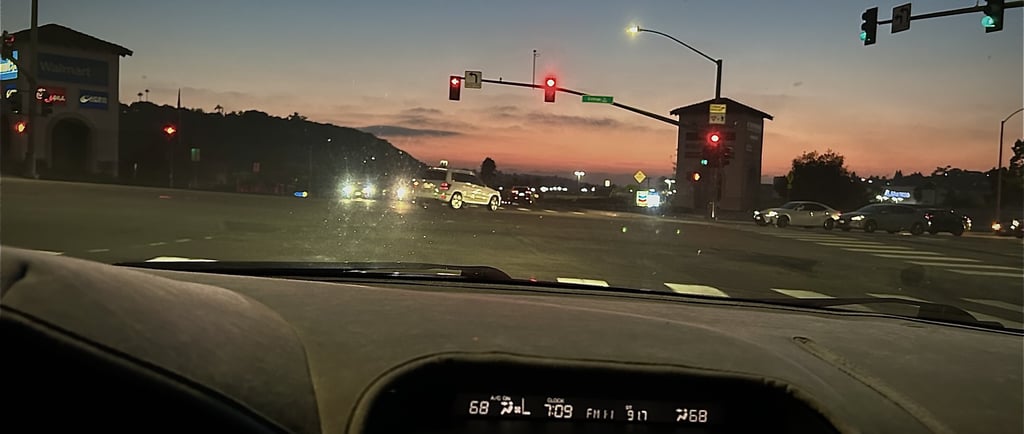
That didn’t exactly happen though. Actually, we never even made it to Rubio’s that day. I don’t personally have any memory of what happens at the intersection of Oceanside Boulevard and Arroyo Avenue, but I’ve asked my parents so many times that it feels like I do.
My dad was sitting in the left turn lane, blinker on, waiting for the light to turn green. I was still awake at this time, but too engrossed in singing to the radio with my sister to be aware of the road around me. It’s not like I would be learning to drive any time soon: I was seven. Then, the light turns green and my dad starts to make the turn, and, to the best of my own memory, there’s this grand earthquake-like shake before everything goes black for a while.
Apparently, there was a car on the other side of the road going straight and straight and not stopping even though their light had long turned red. The man driving had his head down as the car sped forward. My dad, who’d only noticed once he’d already turned into the intersection, slammed the gas in a last ditch effort to avoid the incoming catastrophe. It wasn’t enough though, because the impending car met the side of our bright white Mazda 5, right where I was sitting. This must have been the grand earthquake, the impact of one car hitting another at forty miles an hour and then spinning and sliding and coming to a halt somewhere on the sidewalk. That’s not where a car is meant to be.
All the other people waiting at the intersection are stunned, some coming out of their cars to help and most with their phones to their ears. There are car parts littering the ground, and honking coming from the next intersection over. Those people can’t tell that the intersection is blocked by two wrecked cars and tens of worried people, but they can feel their own annoyance bubbling up at the seemingly reasonlessly stopped traffic.
As soon as he breaks out of his shock, my dad turns back and around his seat to check on me and my sister. He, himself, isn’t too badly injured, although he probably wouldn’t even have been able to tell if he was due to the adrenaline. Scratches litter his body, where the seatbelt dug a little too far into his skin to keep him safe, and bruises would later bloom where the airbags broke his momentum. My sister is much in the same shape. She’s too young to really know what’s going on, so she’s crying from the shock and the pain. My dad’s eyes find her on the floor of the car, where she’s awkwardly situated atop the small pink car seat that flew out from under her, slipping her out of her seatbelt with it. I thought car seats were meant for safety. When I learned what happened to her in the stories recounted for me later, I became skeptical of advertisements. Their proclaimed safety could’ve been her official doom that day, had she been sat where I was sitting.
My dad’s eyes landed on me next. My still, quiet body slumped over, knocked out completely cold with blood dripping down my head where it had hit the window, and appearing essentially lifeless. I remember my dad telling me years later, “I thought you were dead.”
There’s a bit of a gap where details get lost next, though I never asked my parents for clarity because I can sense a deep seated anxiety in those memories that I’d rather not dredge up for them. Once the police arrive and confirm I am not dead, there’s this quick chain of rather large events in their stories: I’m loaded into a helicopter, put into a hospital forty-five minutes away, and then I wake up three days later. My parents couldn’t even be on the helicopter with me, they had to drive all the way to that hospital. The same damn hospital in which I spent six terrible weeks battling a paralytic disease only a year and a half earlier.
When I woke up, the doctors asked me a series of questions. “What year is it?” “What’s your sister's name?” “Do you have any pets?” “How old are you?” “Do you know where you are?” Thankfully, I proved that my brain function was still one-hundred percent intact and I passed their basic-knowledge test with flying colors. You couldn’t hear it, but there was this huge sigh of relief and this vague sense that a miracle had just happened. Most people don’t expect you to leave two skull fractures, brain inflammation, and traumatic brain bleeding without some kind of permanent damage.
I hadn’t really been aware of how precarious my situation was at the time. Other than a dull headache, I couldn’t tell there was anything really wrong with me. The worst part of the situation, to me, was the six week ban on dancing and any kind of rough-housing. Hawaii being cancelled–that I could handle, and we rescheduled it to the next year. What’s to lose if you’ve never had it in the first place? But no physical exertion, no playing or running or entertaining myself in the ways I loved: that was what really disheartened me at the time. I was bored. So, incredibly, bored. I didn’t even understand how close I’d come to death or permanent brain damage until my parents told me the true extent of my injuries years later. I was just a kid.
And that guy, the one who ran his car into ours, I wonder about him sometimes. In the police report, it’s said that there was alcohol in the front seat and speculative but probable evidence he had been texting at the wheel, based on his downward looking at the time of the accident. It’s almost laughable. Those are the first two things they tell you in school. Don’t text and drive. Don’t drive under the influence. Even my third-grade self was taught those basic safety rules alongside “wear your seatbelt” back then.
My parents told me they decided not to file additional legal charges against this guy, past the typical incident report or whatever. Something about him not having the money in the first place, and so we wouldn’t even get anything and he’d just go even farther into the trenches, and so it was better to just settle things with insurance and move on. I just trusted their word on it.
As time went on I began to wonder, though, if this left an impression on him anywhere near the impression it left on us. He got off with only the most basic consequences and didn’t experience the things we did. He, like my dad, was merely bruised and scratched and essentially scot-free.
But he didn’t turn around to believe his child was dead in the backseat. He didn’t spend agonizing days in the hospital anxiously waiting for his child to wake up, not knowing what kind of damage would come. He probably returned to normal life in a matter of days, while my family had to restructure everything we knew for the six weeks it took me to recover fully and quite miraculously.
And so sometimes I wonder if that guy just turned around and did it again.
Jaden Vale is an emerging writer from California, currently based in Tokyo, Japan. They are attending university for literature, transcultural studies, and journalism. They are particularly fond of intellectual and philosophical history, or in other words, exploring the ways that people have thought and how it has impacted the course of human existence.
Subscribe to FREE digital flip copy of the Adelaide Magazine printed edition.