ON THE MOVE
ALM No.87, March 2026
SHORT STORIES


* Based on a True Story
Part One
“Everything that’s alive moves. If it didn’t, it would be stagnant; dead.” – John Africa
May 12, 1985: West Philadelphia
“Happy Mother’s Day, Mama!”
Gene galloped around the kitchen table, holding aloft the homemade Mothers’ Day card he had brought home from school on Friday and somehow restrained himself from revealing for two-and a-half whole days.
“Thank you, baby,” Mama responded, smiling fondly at her eldest child and only son. “Did you draw you and me? What a beautiful card.”
“I used the white crayon to make violet,” Gene began, preparing to recount the entire artistic journey from blank page to Crayola-hued landscape featuring Madonna and Child under a lopsided rainbow, but was interrupted by the grating chime of the ancient doorbell.
Mama rose from the table and started toward the door – Gene trailing after her like a duckling, still clutching the card; Little Sister following on unsteady legs – then paused to push aside the lacy curtain shading the small window next to the porch. She gave an audible inhale; her hand stilled in the air.
A strange shadow crossed her face that Gene didn’t yet know enough about the world to identify, a shadow which stirred something instinctual deep in his heart that made him feel protective of her; that made him think of his dead father. Later, he would learn to identify that shadow as the epigenetic trauma of Blackness; later, he himself would always have the same knee-jerk reaction to the sight of police at the door.
“Mama?” he asked uncertainly, unnerved by the shadow; unnerved by her momentary immobility. Little Sister arrived and clung to Mama’s legs. The doorbell grated once again.
Mama’s hand came down and shoved Gene roughly behind her skirt. She hauled Little Sister off the floor like a sack of flour and clutched the baby to one plump hip. Mama closed her eyes briefly, then opened them wide and unlatched the front door.
“Good Evening, Ma’am. I’m Officer Frederick Dukes with the Philadelphia police, 12th District. This is Officer Green.”
“Good evening,” Mama said stiffly. Gene tried to peer around her legs at the tall men with the radios and the nightsticks – and guns, he couldn’t tear his eyes away from the guns – and was promptly re-shoved behind her skirt once again.
“We’re just out here advising residents that they should evacuate tonight, just temporarily. Take some clothes, some toothbrushes. You’ll be back in a day, but it’s for your safety.”
Later, Gene would understand why the understated fear on his mother’s face dissipated with the officer’s first sentence; later, he would understand why she scoffed imperceptibly at the end of the last one.
“Our safety?”
“There might be some trouble tomorrow. We’re getting you folks out of harm’s way. You know, for your safety.”
“Yes, safety,” Mama agreed, as if she had any other choice about any other thing to say. “What sort of trouble?”
Officer Dukes looked annoyed.
“The folks over at 6221. We’ve got some arrest warrants to serve. We’ve had enough complaints about them, with all their trash and the fucking bullhorn…”
The officer finally seemed to spot Gene and Little Sister.
“Oh. Excuse my language, ma’am.”
“Do you mean the MOVE Group?” questioned Mama. The policeman nodded curtly as Mama shifted Little Sister to her other hip.
Gene knew about MOVE. All the children on the block knew about MOVE. Gene wasn’t entirely clear on who they were or why they were important – why there were so many men and women and children and dogs living in the same house; why they would shout through a bullhorn about animal rights for hours at a time; why the adults in Cobbs Creek would always talk about “The Move 9”; why they would lower their voices when doing so – but he knew MOVE was different. He knew they had some sort of power. He didn’t know if they were dangerous…but he knew enough not to linger too long on the sidewalk in front of their neglected property.
“MOVE are terrorists. We don’t trust them. We just want to be prepared if they don’t surrender peacefully. You’ll be back in the afternoon. It’s, you know, for your safety.”
Gene looked up at the uniformed officers, his gaze flitting once again from pistol to handcuffs to badge. He understood the word “safety”, and he thought he understood the word “surrender,” and even at his young age, he definitely understood that you never argue with the police. But none of that explained why he felt out of breath, why the electricity of anticipation was suddenly in his veins, like when he broke the lamp and was just waiting for Mama to find out. None of that explained why he suddenly felt the need to apologize; to behave; to prove that good behavior and to be validated for it by these unknown men with their air of authority.
“Thank you, officers,” said Mama obediently, and Gene wondered vaguely why the knuckles on the hand restraining him behind her legs were white with tension. Maybe “surrender” meant something besides what he thought it meant; maybe she felt the electricity as well.
The policemen retreated from the front door, talking inaudibly between themselves. Mama stood staring out at the neighborhood for a moment more, her eyes shifting from the officers to the house across the street at 6221 Osage and back to the officers again. Then she sighed.
“C’mon, baby,” she said at last. “Let me get supper started, and you can finish telling me how you made my card.”
Part Two
“Attention MOVE! This is America. You have to abide by the laws of the United States.” – Gregore Sambor, Philadelphia Police Commissioner
May 13, 1985: West Philadelphia
“Should I make another pass, Lieutenant?”
Corporal William O’Leary glanced warily at the cabin seat.
“Lieutenant Powell?”
It had been five full minutes since he’d lifted the copter off the flight pad at 63rd and Walnut, and William still had no idea where he was flying or why it was necessary.
He was accustomed to following orders from his superiors – it’s why he joined the force in the first place – so operating solely under the hazy instructions of the man to his right with the thousand-yard stare was really starting to stress him out.
“Sir?”
Lieutenant Powell didn’t shift his gaze from the side window. He sat uncannily still, only his temples pulsing with the force of his grinding molars. The green satchel cradled in his arms like an infant seemed preternaturally bright, and William suddenly thought of Chekhov’s Gun for no reason he could discern.
“Make another pass,” the Lieutenant finally ordered. “Back to 62nd.”
“Yes, sir.”
William flexed his foot against the anti-torque pedal and felt the copter swing around. Below, he could almost make out the stanchions of the roadblock, the faces of the feverish officers, the flash of the reporters’ cameras; he could almost see the residue of gunpowder hanging above the street like a scrim.
Everyone was on edge, had been on edge since early morning during the commencement of the siege. William, one of the hundred officers called upon to execute MOVE’s outstanding warrants, had been present the entire time. He had watched the standoff, his eyes stinging from tear gas. He had fired his weapon when the gunfire broke out – thousands and thousands of bullets ultimately discharged by the force over a 90-minute span – not entirely sure where he was aiming or what the target should be. Later, he had seen Mayor Goode’s press conference from the sidelines; he had heard the mayor vow to seize control of the home by any means possible.
Now it was 5 p.m., and all he knew was his instructions to take Powell up in the copter. William didn’t often work with Lieutenant Powell; head of the Philadelphia Bomb Disposal Unit, Powell’s path didn’t usually cross with those of the police aviators. But Commissioner Sambor had issued a flurry of orders earlier that afternoon, barking into his radio while rushing from the barricade to the mess of police cars to the reporters’ glowing cameras and back again, and ever since, William had been responsible for taking the Lieutenant – and his eerily vacant expression – wherever he needed to go.
They were approaching Pine Street when the radio on Lieutenant Powell’s belt came to life, an authoritative voice emerging through a miasma of static.
“C-4 Tovex…the satchel…use caution when…confirm target …over.”
William blinked.
“Roger that,” Powell responded, and shifted the green satchel to the crook of his other arm.
“Sir?” William voiced, wondering what the hell was going on, wondering why Tovex was necessary, wondering why the Lieutenant was now rising from his seat, hunched over to avoid cracking his head on the ceiling.
“Head to the scene,” Powell ordered, lumbering awkwardly through the periphery of William’s vision and exiting his line of sight.
Later, it would be this image which would return to William as a sense memory, a flashback in the future bringing him back to this place, to this time, to West Philadelphia in 1985, even after he was elsewhere and old. It was this moment, this impression of the Lieutenant’s retreating back, that he would picture when he closed his eyes at night, years down the road.
William would often wonder why this was then case…why he wasn’t plagued by any of the other sights he witnessed that day. Long after he retired, it was not the dazzling light of the explosion that still played on a loop against the back of his eyelids; it was not the flashes of gunfire blocking the burning home’s only exit that kept him awake. Instead, everything would be this moment – Lieutenant Powell moving away towards the swing door, nearly bent in half, satchel still held gingerly against his midsection – and this moment would live forever.
“Sir, what are we…?”
William’s voice trailed off as Lieutenant Powell grabbed the handle and flung open the door, wind immediately rushing into the copter and nearly drowning out the man’s response.
“Flushing out the suspects,” he replied curtly, and William, like a soothsayer, caught a sudden glimpse of the future. This newborn knowledge sat heavy in his forebrain, a weight on his thoughts as he mentally followed the situation out to its logical conclusion. He pictured the satchel with its dirty green hue; he heard Chekov whisper in his ear once again. Feeling like Cassandra of yore, William’s fingers tightened on the cyclic stick as his blood pressure shot into the stratosphere.
But what else can you do? his inner monologue questioned, and William was inclined to agree with it. This wasn’t a choice; there were no other options. Orders were orders, and what else had his lived experience prepared him to do but follow them without question?
Tilting the rotor disc and adjusting his pitch, William approached 6221 Osage Avenue. Far below, he could see the milling mass of police and civilians and residents and rubberneckers; the bunker at the MOVE compound sat innocently upon the roof.
“Right over the bunker,” Powell barked over the discord of the wind. “Keep it steady.”
The Lieutenant clutched the doorframe, then carefully made his way onto the skids, the ground hundreds of feet away and the satchel nestled under his arm. William imperceptibly nudged the cyclic stick; he checked his altimeter; he arrived at the mark and began to hover. His hands were slick against the aluminum. His heart hammered like a drum.
Balanced precariously on the skids, a fuse igniter in one hand, Powell held out the satchel and brought the igniter close. He paused for a moment to bellow over his shoulder into the cabin.
“45 seconds, Sargeant!”
Time slowed for William, even as the next few seconds raced by at unimaginable speed.
Einstein was right, William thought wildly. Everything is relative.
Then the bomb fell, sailing gracefully end-over-end, plummeting towards the row house directly below.
William did not watch it hit.
Part Three
“The City that Bombed Itself.” – Dr. Charles Abraham, James Madison University
May 13-May 14, 1985: West Philadelphia
“Let the fire burn.”
Gregore Sambor fell silent and Robert waited, certain there was a follow-up to this statement, certain he was misunderstanding.
“We need to flush them out,” Fire Chief William C. Richmond had just stated, looking to the police commissioner for insight. William C. Richmond, to be clear, was not one to accept failure. MOVE was still barricaded in the bowels of 6221 Osage, and Richmond seemed to interpret that fact as a personal offense.
Robert, too, expected Sambor to have the answer; he, too, presumed there was a solution to this problem, a balm of Gilead that would ease the tension and resolve the conflict and protect the children inside the house. But then Sambor said to let the fire burn, and then he didn’t say anything else, and now Robert was left in the bowels of the silence that followed.
It was 6:30, but no one would have been able to tell. The gray clouds were still drizzling rain. The smoke hung lazily in the air. Everything was washed in an unnatural haze, the air itself a sickly shade of orange. It could have been midnight or 7:00 in the morning; it could have been West Philadelphia or Hell.
“Chief?” Robert questioned, pulling the fire helmet from his head to better consider his boss.
Richmond did not acknowledge Robert. He did not respond to Sambor; he did not issue instructions to the brigade from the radio hanging from his belt. He simply nodded, crossed his arms, and watched the fire burn.
The explosives had ignited a gas can. The gas can had ignited the house. The flames were immediate, an entity of their own, consuming 6221 Osage and beginning to sear away at its bones.
“Chief, should we…?” Robert tried again.
“Negative,” answered Richmond, and followed Sambor back towards the barricade.
Baffled, Robert looked to Michael, the rookie, and raised his eyebrows. Michael shook his head, removing his own helmet and placing his hand roughly against Robert’s bicep.
“Don’t, man. Don’t do anything.”
Robert shook off his hand but remained in place, staring up at the roof of 6221. He heard the sopranic melody of breaking glass; he saw a tendril of flame lick out from a downstairs window, tasting the air of freedom outside. Across the street, Richmond and Sambor were deep in conversation, their backs to the burning row home, their arms crossed over their chests.
“What are they doing?” Robert questioned, rhetorically but vehemently. He already suspected the answer; he already suspected why.
“Flushing out the suspects,” Michael answered, perfectly quoting the Chief. “It’s not like the tear gas worked.”
Robert had heard this, too, from Sambor and his loyal force of merry pranksters. He heard it when the blast from the bomb shook the neighborhood. He heard it between bursts of gunfire. The words made no more sense this time than they had any of the previous times; Robert knew how fire worked.
“There are women and children in there,” Robert pointed out flatly. “It’s a damn row home. Why aren’t we hooked up to the Johnny Pump already?”
“Dude, it’s not like we can go in there. We’d totally get shot. The Chief knows what he’s doing.”
Robert shook his head in disgust. It didn’t much seem like anyone knew anything about what to do in this precise situation, but he was relatively certain that allowing the fire to burn was not the way to rectify it peacefully. Peace, he suspected, had no place in West Philadelphia today.
We’re coming out! We’re coming!
Even over the roar of the flames, the woman’s voice was shrill; panicked. She must be near the front window, Robert thought; he could hear more panic, a chorus of different voices, somewhere around or behind her. He made out the reedy cry of a child. He pictured a little girl, ostensibly clutched to someone’s breast amidst the smoke and heat, and then watched as her face transformed into the dimpled cameo of his own daughter.
Robert! someone was yelling.
He felt frozen, frozen in place by the sound of the woman’s voice and the child’s terror. The world continued to spin by at an unimaginable rate – fire and shouts and now the steady heartbeat of gunfire – while time in front of him slowed to a crawl. The moment contained only him and the woman and the little girl; only the little girl was his little girl, and every other little girl, and they all somehow looked exactly like one another, all at the very same time.
Robert, look out!
It was Michael the rookie, Michael was yelling, and Robert looked around uncomprehendingly. Michael was behind the barricade now, frantically gesturing – how had he gotten there? – while smoke billowed and the child cried and casings fell to the ground like the synesthesia of rain.
They’re coming out the back, they’re coming out the back!
Robert didn’t know who was yelling, but the exclamation echoed all around him, spreading through the ranks like a virus, growing in volume until it was the only thing that mattered. The sharp shooters repositioned frantically to find a better angle; a fresh wave of gunfire erupted, bullets seeking bodies, seeking the back door and anyone they might find there to serve as a glorious target. Robert watched it all, watched it until an unknown firefighter body checked him to the ground and dragged his back to the barricade. Then he simply sat, watching the flames.
Hours passed. The fire grew. It spread, to the row houses on either side and then the ones on the other sides of those. The heat was tangible and viscous, breaking upon the officers and firefighters in swells. Grit blanketed every exposed surface; ash rained from the sky.
They let the fire burn.
Part Four
“Slavery never ended. It was just disguised.” – Janine Africa
April 21, 2021: University of Pennsylvania Museum of Archaeology and Anthropology
“Where is the fucking statement?”
Sweat ran down the back of Gene’s neck.
“We have twenty fucking minutes, where is the fucking statement???”
It was Monday. It was 10:35 in the morning. Gene was still hungover from yesterday’s game-day barbecue – which had been necessary to decompress from the absolute shitstorm at work the week before – and now he felt entirely unprepared to play his role in the Greek tragedy in which the Penn Museum was today inextricably embroiled.
“Put in something like…human remains need to be treated with…with respect, and…something about dignity.”
The glamour of Executive Assistantship, Gene thought sardonically, typing as fast as he could. He had always said he was willing to do whatever it took to get his Ph.D…but he hadn’t bargained for the cutthroat biosphere that is Academia, for the privilege and the pretense and the prejudice and the publishing and the perishing.
So here he was, just a peon in the office of the Director of the University of Pennsylvania Museum of Archaeology and Anthropology, hoping for his big chance. Everything about it would be entirely unremarkable…except the museum in question had just discovered it still housed human remains from the MOVE bombing, housed the bones of dead Black babies who were burned alive, housed them in a box on a neglected shelf and forgot all about them until just last week.
“Where the fuck is the statement? The fucking Guardian beat us to it, c’mon!”
Gene’s boss held up his hand in a gesture that both conveyed impatience and pleaded for mercy, attempting to keep the enraged university spokesman at bay. He leaned in close over Gene’s shoulder, staring intently at the computer screen, and Gene did his best not to outwardly react to this invasion of his personal space.
In his boss’ defense, this situation really was just as bad as everyone feared, a failure of both ethics and optics, a tangible reason for donors to turn their charitable intentions elsewhere, and here the Director was – right at the helm, crushed under the weight of U Penn’s bloated endowment like Atlas with the sky upon his back.
“Gene, you put a ‘t’ in ‘deserve’, backspace, backspace!”
Another rush of neurotransmitters flooded Gene’s limbic system. He felt his heartbeat begin to thud behind his eyes. His back teeth ground together; his fingers trembled imperceptibly.
It is not MY fault you guys fucked up here! Gene shouted silently into the void, his wooden fingers clattering over the keys while the Director ogled his progress and exhaled directly into his ear. Type your own damn statement!
Only it wasn’t just that the museum stuffed the remains of dead children into a closet and then forgot about them for 30 years; it wasn’t just that the University of Pennsylvania loaned human bones to Princeton like trading cards. It wasn’t even that the Office of the Medical Examiner tried to cremate those bones back in 2017 without notifying the surviving MOVE members – and then somehow messed that up, too, so back into the closet they went.
No, it was actually that the Penn Museum, the Powers-That-Be, the entire fucking city – they had all managed to denigrate the bodies of Delisha Africa and Tree Dotson even further, even beyond the grave, even more extravagantly than they had been denigrated by the bombing in the first place. The Billy Penn exposé indeed shined a light on the missing MOVE remains…but it also exposed the collective, overarching, willful ignorance of Black humanity that plagued Philadelphia the entire time.
It was with this comprehension that Gene grappled as he continued to type, as his boss brainstormed possible sentiments and lobbed them out into the ether, trying each on for size to see what might fit. They were words of apology, empty words, and Gene’s fingers were apparently to be their primary vehicle and mode of delivery – a fact about which Gene was starting to have mixed feelings, because Gene was now thinking about the events of May 13, 1985.
Some of these images were sharp in his memory, like seeing his mother weep for the first time as she watched their home burn on NBC from the safety of his aunt’s living room. Others were hazy, like the tang of smoke in the air and the otherworldly orange glow when the sun set; like trying to fall asleep that night; like the sound of the bomb. Still others were not images but facts – not his own impressions but experiences-by-proxy – a Mandela Effect wherein lines in a book and headlines on the news transposed themselves as his own memories, his own lived history.
But you couldn’t be Black and live in West Philadelphia and not know these facts, facts which echoed through Gene’s childhood neighborhood like a wind, the neighborhood he had never left. 11 dead, five of them children. 61 homes burned to the ground. 250 voters unhoused in 12 hours, with no civic recourse or path to getting housed once again. No accountability. No repercussions. No apology.
And now this.
Now, it turned out two more children had been dismissed as storage, their bones bartered between Ivory Tower Academics, destined to be incinerated like waste and then forgotten once again, dehumanized and disrespected and denied any sort of peaceful rest, and their living relatives none the wiser to any of it.
Until now.
Now, it was Gene who was responsible for recording the university’s mea culpa regarding the entire fucking mess, Gene who was contractually obligated to take down his boss’s dictation like a parrot. The words about to be published around the nation and across the ocean came from his keyboard, were a direct result of his own fingers and his own free will. Sure, they weren’t his words, but isn’t complicity the same thing as acquiescence? Isn’t enabling the same thing as support?
“Ten fucking minutes! Are we inventing the fucking printing press first? Where is the goddamn statement???”
The university spokesman was purple. Gene’s boss was essentially sitting on Gene’s lap, his words pouring through his assistant like a ventriloquist with his eerie, compliant dummy. The tension in the air was something palpable, something malleable like taffy, and it tasted to Gene like being in trouble, like being late or lost; it tasted like cortisol. He proofread the Museum’s official statement – which, as of now, existed only in an Outlook draft on Gene’s computer, only at an IP addresses which identified Gene and no other like a scarlet letter – and he thought about Anthropology. He thought about the West Philadelphia he came from and the West Philadelphia of today. He thought about justice and ethics and his looming Ph.D. He thought about May 13, 1985.
“Gene, that’s it, that’s fine! Sign it from the Provost and send it!
It was 10:52. The press conference to be held by MOVE relatives and the fractured remains of the Africa family was due to start at 11.
“Send it now!”
The statement would go from Gene’s email address to that of the university spokesman, who would forward it to the President of UPenn for final approval. There was no time for Gene to untangle his increasingly-complicated feelings, no time to formulate a plausible defense for why he should not be the one to set these events in motion. He had no recourse, no authority, no time to think; and as much as Gene knew he wanted no part of belonging to this particular side when it came to this particular debate, he also knew his entire academic future would be determined by the mouse button he did or did not decide to click in the next three seconds.
“Kid, I swear to God…”
The university spokesman looked ready to resort to physical violence, but what did he know about trauma? What did he know about being Black in Academia? What did he know about the skyline on fire, or ash raining from the sky, or watching his own home destroyed to the soundtrack of his mother’s tears?
The Director was on the phone, presumably with the President of the University, promising her the statement was being sent to the spokesman by his assistant right now, his eyes narrowing at Gene and his index finger twirling aggressively in a “hurry up” motion with each word he spoke. Gene’s mind flashed briefly to Delisha and Tree – reduced to objects and unavenged – their bones apparently holding value only now that they were dead.
The time switched to 10:54.
Gene exhaled heavily.
Then he clicked the mouse.
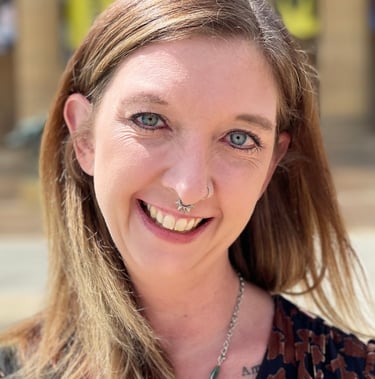
Shannon Frost Greenstein (She/They) resides near Philadelphia with her family and cats. She is the author of “Through the Lens of Time” (2026), a fiction collection with Thirty West Publishing, and “These Are a Few of My Least Favorite Things” (2022), a book of poetry from Really Serious Lit. Shannon is a former Ph.D. candidate in Continental Philosophy and a multi-time Pushcart Prize nominee. Her work has appeared in McSweeney’s, Pithead Chapel, Nimrod Journal, and elsewhere. Shannon’s passions include Friedrich Nietzsche, anti-racism, the Seven Summits, the Hamilton Soundtrack, and acquiring more cats. Find her at shannonfrostgreenstein.com. Bluesky: @shannonfrostgre; Insta: @zarathustra_speaks
Subscribe to FREE digital flip copy of the Adelaide Magazine printed edition.