REMEMBER TO FORGET
ALM No.86, February 2026
SHORT STORIES


“Sorry,” she says, sitting down. “I forgot where I put my house keys, took forever to find them.”
Clive nods. He doesn’t have any particular desire to be here, nor does he mind waiting an extra twenty minutes. He simply accepts her excuse, admitting, once again, that he is not like other people.
He never forgets.
He places himself briefly in Madeline’s shoes, imagining what it’s like to misplace something in your own house. Clive amuses himself this way sometimes, putting his things in all the wrong places: his credit card between the pages of a random book, his keys in the kitchen drawer, his lighter in the pocket of his pants down in the laundry room.
But every morning, mechanically, he knows exactly where to find them: the exact page number where he stashed the card, what he wore at that moment, the time on a clock while he thought of a good way to hide it.
Not even halfway through the date, Clive tells Madeline about his strangeness, his condition, wanting to move past wondering questions and weird looks, throwing his secret out in the open.
“You’re lucky,” she tells him. “I wish I had a memory like that. It’s a blessing.”
“Blessing,” Clive snickers. “More like a curse.”
She doesn’t mind, she tells him, and he believes her. She sips her wine, asks him questions about life and work, but he can sense a shift in her now, although not the one he usually inspires. Madeline is curious, studying. Clive feels a little uneasy under her gaze.
It’s only after she turns, examining the restaurant, that Clive allows himself a moment of unguarded observation, and, immediately, appreciation. He doesn’t want to remember the slope of her neck, the long lashes, the brown hair pulled elegantly into a twist. He doesn’t want to remember the sound of her voice, more timid than he expected, or her jasmine perfume. But already he knows that these things are ingrained in his memory, like carvings in the trunk of a young oak, growing ever noticeable with time.
By the end of the first hour, he likes her. By the end of the second, after she suggests swapping the overpriced restaurant for an ice cream shop, he really likes her. But he can’t ask for a second date: Clive remembers, with a shudder, how depressing his weeks were after his last break-up. As if it happened merely seconds ago, he recalls exactly what he felt, vowing to never fall into the same trap. He cannot date someone he really likes, someone whose absence splits his heart in half, whose every habit, every smile, every joke will haunt him for the rest of his life.
So when he walks Madeline to the bus stop, he says nothing, and she doesn’t pressure.
“I had a very nice time,” she smiles up at him.
There, under the street lamp, Clive curses to himself, watching the dazzling light reflected in her eyes. It will take him a while to get over her. Time heals, people say. Well, time is not as kind to Clive. It only makes every moment, every memory sharper.
“Here,” she says hurriedly, as if she only has so much time before forgetting. “Write down your name.”
She pulls a pen out of her bag and extends her arm in place of paper. Clive looks at her, puzzled.
Is it possible that she has already forgotten his name?
He wraps his hand around her wrist, spelling his name across her skin. And before he can even return the pen, she dashes towards the bus, screaming something over her shoulder that he cannot make out.
For days, nothing happens. Clive tries not to recall the date as much, as if it would make the memory magically fade. This is how it works for others, he thinks to himself. Millions of ordinary moments pass in front of them, and all they have to do is pluck out the important ones, the ones they’d like to revisit.
Clive does not distinguish them. He can walk into any random day inside the chamber of his mind. Nothing special stands out.
It is this way at least, until Clive sees her in the grocery store. Madeline stands in the vegetable aisle, reading the label on packaged tomatoes, and Clive feels every bit of air hollow out of his lungs.
Uncertain for a moment, he decides to at least say hi.
But when he calls her name and their eyes meet, there is no flicker of recognition in hers.
“I’m sorry,” she says, placing the tomatoes in her cart. “How do I know you?”
The question sounds so genuine, so uneasy and unsure, that Clive doesn't even feel wounded. Madeline shrinks, her posture both guarded and uncomfortable.
“Clive,” he introduces himself again. “We went on a date the other day.”
“Clive,” she repeats, wide-eyed. There is relief, apprehension, and oddly, traces of joy in her expression, like a kid slowly unwrapping their Christmas present, glimpsing what’s inside.
Her shirt covers her arms, but when she lifts her sleeve, there it is, his name, still in his handwriting, but retraced with a marker that’s already started to fade. Underneath, in small letters, it reads, please remember him.
He looks back at her, understanding surging in like a powerful tide.
He wants to laugh then, at the asymmetry of their situation. Two sides of the same coin. Two parallel lines that should never cross, but somehow found a way.
Clive thinks, slightly prematurely, about how every day she will forget him, and how he will always remind her. A million special moments now, each one a new introduction, never the same. He thinks how it is indeed a blessing, to have already memorized every line of her face, to be able to hold it in his head with such precision.
A blessing, not a curse.
“So you’re Clive,” she says, grinning now. “I finally found you. It's nice to meet you.”
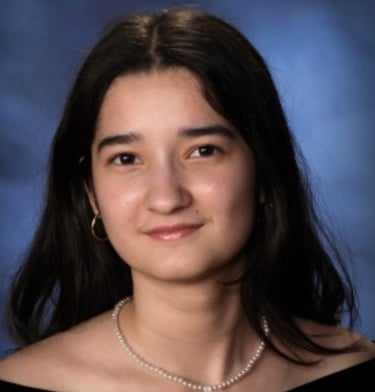
Amina Odinaeva is a writer based in New Jersey. She studies English and German at Montclair State University. Her writing focuses on fiction pieces that explore emotions and human connection.
Subscribe to FREE digital flip copy of the Adelaide Magazine printed edition.