SHE: THE FOURFOLD AGONY
ALM No.87, March 2026
POETRY


Poem 1:
Mother
(September 15, 2010)
When she passed,
The drizzle didn't hum a melody,
But the road kept flowing just the same.
In the mind, the spinning wheel—
Rotating in a hollow void—
Carried the rustle of ankle-bells,
Accompanied by the persistent ring of a missed call.
With practiced hands, the father peeled the stalks,
Bundled the cane, and thrust the batch into the crusher.
And we stood there in a row,
Holding empty glasses.
How could we cry with heavy clouds?
The sugar had been sucked dry,
The water already expelled long ago.
On the fierce pyre, that bone-dry bagasse* Burned away in a flicker!
(Without even a hope for a single drop of water.)
She was so enduring, so mindful of others,
That even the cracking of her skull... she kept cautious and hushed.
And our lingering feet turned back,
Toward our own worlds, our own chores.
No matter how much you deny the truth,
Every mother is just like this—
Emerging from the crusher, and...
Burning away in a flicker.
Even this poem of mine about Mother
Is bone-dry!
To the dry routine of every day,
To the dry bread of every day,
The legacy of adding a touch of Puran*—a dollop of sweetness—
We could not carry that weight."
We could not carry that weight.
There are no tears,
Nor is there a lump in the throat that won't be swallowed.
I am...
Desolate, stunned!
Watching a knot of destiny unraveling,
Astonished.
Tending to my loneliness
On this very globe.
Footnotes for the Reader:
Bagasse: The dry, pulpy residue left after extracting juice from sugar cane. It symbolizes the mother’s exhausted life after giving everything to the family.
Touch of sweetness (Puran): A reference to 'Puran Poli,' a sweet stuffed bread. It symbolizes the mother's unique ability to bring joy and sweetness even to a mundane or 'dry' existence.
Poem -2
The Gurgle and the Agony of the River
Once,
The river’s gurgle was a melody.
Flowing from the heights to the gentle slopes,
The sound would slowly fade,
Like a master singer bringing a soaring note
Gracefully back to the base.
'Kissing every stone on its path with moist devotion,
This proud beauty journeys to meet the ocean'—
This metaphor has fed generations of poets.
While flowing, she embraced the motherhood of the banks,
Her ripples, a quiet acceptance of life.
I remember mornings on a river stone,
Splashing rainbows in every drop,
Or keeping my feet still, letting tiny fish cleanse them.
Leaning over to see the world within her—
White, green, and azure pebbles,
Shells resting like infants on a soft bed of sand.
The reeds clinging to rocks, resisting the current’s urge to pull them away,
Like a child clutching its motherland.
The fallen leaves of the Banyan or Peat,
Saluting as they drifted past in a playful dance.
And the rhythmic thud of laundry on stones—
The background score to this living cinema.
The river absorbed the grime and the soap suds
With the same gurgling joy,
Like a mother concealing her daughter's flaws within her veil.
Even as my knees ached from sitting,
I, the spectator, never wanted to move.
That was the 'Gurgle' of the river.
But now—
I hear the 'Agony' of the river.
The village on the bank has changed.
Like a modest woman painting her face
And donning foreign robes to hide her grace,
The village has turned into a city.
With reckless abandon, the city has cast its 'progress' into the water,
Like trash thrown from a window.
Plastic bags, rags, and the slick of oil—
The river now flows with a cursed bitterness.
Her translucent skin,
Once dusky, then turned black.
And now—
Beneath that opaque surface,
Where are the shells on their bed of sand?
Where are the fish that played and cleansed?
Where are the reeds that gripped the earth?
The question of the Peepal leaf doesn’t even arise—
The factory smoke has withered it long ago!
Now, my heart thumps with dread as I approach her,
As if I am entering a morgue to identify a loved one’s corpse.
My feet turn back toward the mundane world,
But the river’s 'Agony'... it keeps buzzing in my ears.
The villagers, now city-dwellers, didn't notice her skin turning black,
Because they never looked back at her.
Now, the river only comes up in conversations
About a broken bridge.
Her 'Agony'—
Is beyond their ears, beyond their world.
Who knows if the generation weeping by the rivers of Babylon
Would (they) even recognize this pain?
Today,
I am at an 'Adventure Waterpark.'
A grandfather, who once heard the river’s 'Gurgle,'
Watching his grandson play in the artificial blue...
And the 'Agony' of the river in my soul
Becomes a haunting underline.
The Agony of the river... it keeps buzzing in my ears!
The Agony of the river... it keeps buzzing in my ears!
Poem- 3
O Nature!
O Nature!
You exist in every atom, and you exist in me.
In the erotic adornment of petals and blooms,
Your pollen trembles with desire;
While I am but the restless, wandering Abhisarak—
The lover on the wind!
Our union is the decree of the universe,
Yet, of the 'Creation,' you alone are the Sovereign Queen!
My roar pierces the heavens,
My mane, a royal crest of pride!
But it is on the prey you hunt
That I feast with idle vanity.
I am the symbol of valor, they say,
But as the winter of age withers me, I realize—
I was but a name;
You were the rutting Queen,
And I, a mere slave...
To the act of union!
O Nature!
Sometimes you are the sibilant serpent,
And I, your intoxicated dweller.
But when I, the Serpent-King, lie spent and weary,
It is your venomous sting that remains.
O Nature!
You are the anointed Queen of the skillfully woven web,
And I am but the laboring bee!
Tell me, O Nature—
How is this monopoly of creation entirely bestowed upon you?
This one thought haunted me,
And I stormed towards Brahma in a rage.
"O Father of the Universe!
Upon her and me, you bestowed
The labor of creation.
But why is the 'Birth' hers,
And mine—only the 'Craft'?"
Brahma laughed—a smile, tender, cryptic, and wise.
"Go! I grant you the chance,
In the mortal world of the earth,
Show me your prowess!"
The Father closed his palms, meditating for a breath.
When they opened, the Shivalingam blazed for a moment.
"Keep this in your soul,
The knot that binds you and her!"
As I turned to leave, he whispered, "Wait, one more moment!"
His palms were now filled with the flowers of Moha.
"Take this—this intoxication!" he said,
And showered those maddening blooms upon me.
O Nature!
I manifested in this mortal world,
To conquer you, or to defeat you.
I groomed the 'Female' and bound her to 'Motherhood.'
Erasing the ancient names of the mother
(The Radheyas, the Kaunteyas),
I glorified the 'Father'!
I trapped you in a frame so rigid,
The world called it the 'Threshold.'
I decreed your adornment
Must be offered to a single master.
I, the Vichitravirya—the strangely potent—
Was haunted by the curse of 'Fall.'
Your victory in coitus tormented me,
So I hunted for a thousand excuses
To brand you as 'Abla'—the weak one.
O Nature!
To strike your name from the certificate of creation,
I tortured you endlessly, I tried a thousand ways.
Brahma gave me the chance,
But it turned into a journey of my own vengeance!
Yet, your 'Female' never lost.
The nest, the forage, and the water—she held them all.
Now I know,
Now I know why Brahma laughed then—
That tender, cryptic, wise smile!
None is small, none is great,
None is the wise one, none the ignorant,
In this colossal labor of universal creation.
O Nature!
You are the 'Female' in every atom of this world,
From the elephant to the ant.
I hereby surrender to you the title-deed,
The sovereign right of Creation!
The future shall belong to your reign,
The customs of the Mother’s Name shall return.
I write this confession—but
O Nature!
Do not overflow, do not be intoxicated with power,
Do not let the balance of you and me
Waver in this sacred Lingam!
O Nature!
In this mortal world of the earth,
I address you by one name—
Woman.
...
...
Happy Women's Day!
— Man
Poem-4
The Globe
On this globe:
Here, in the Middle East—
When burqas, niqabs, and hijabs are being flung into the air,
And the Muktanganas who dare to fling them are sentenced to death;
Here, in the Indian subcontinent—
Suffering the curse of dowry-deaths from decades ago,
A man past his forties stands, with a Bashing tied to his brow, waiting to wed;
Or operating a sex-determination center from within a van,
Reviving the pre-prophetic ritual of burying infant girls alive;
And here—in the advanced West—
Behind the sheer, gossamer curtain of ‘freedom,’
The female body is curated for the male gaze;
Perhaps, the human race is cursed
To repeat the same mistakes through the ages;
Maybe that is why the Earth is ‘round.’
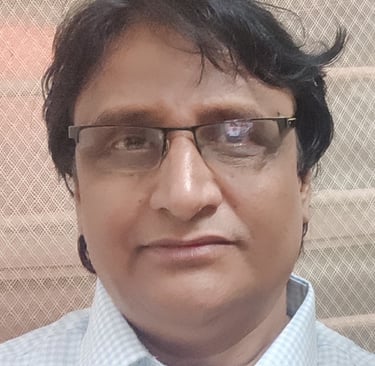
Mr.Manoj Mahajan is a versatile Playwright, Storyteller, and Screenplay Writer with a keen eye for dramatic tension and futuristic narratives. He is the author of the poignant poetry collection 'She: The Fourfold Agony'. With a body of work that spans from evocative stage plays to compelling screenplays, Mahajan explores complex human emotions and cross-cultural dynamics. His writing, known for its cinematic quality and profound depth, bridges the gap between traditional storytelling and contemporary global themes.

Subscribe to FREE digital flip copy of the Adelaide Magazine printed edition.