THE PRE-FIRST
ALM No.87, March 2026
SHORT STORIES
Marcel picked a creased Cyrillic pamphlet from the folding table and thumbed through in search of an English label. Having started to work on his Russian a few years before retirement, he still couldn’t tell a Soviet printing of Gogol from a seed catalog. He opened his mouth to ask the vendor if he knew the title, but stopped. If he needed help for so little, he would never be able to assess the booklet’s value with any confidence.
Not ready to give up, he continued to scan the pages for any phrases he recognized. This was the reason he had started learning, even though the effort had ended up outliving his career. The antiquarian booksellers’ fair reminded him why he was happy to have converted his profession into a casual avocation, though not without those old saddest-are-these. Marcel Seordi—All Published.
The steel-domed convention center was replete with exhibitions and sales tables, milled by an equal representation of connoisseurs, hobbyists, and the idly curious. Despite the size of the crowd the noise never exceeded a museumlike buzz. Like the great reading rooms of old libraries, the echoing volume made the first person to raise his voice become immediately self-conscious.
He startled at a voice reading from behind his shoulder: “Adjusted Steel Production Figures, Magnitogorsk, 1948-49.” An airy laugh. “Found your white whale, Shorty?”
Marcel smiled and turned with a shade of reluctance. “Just wishing I’d brought my lexicon.” He set the Russian book down again. “Long time, Lucilla.”
“Please, buy it,” Lucilla urged him. She was about his age, thin, with brittle white-blonde hair and expensive clothes that didn’t look it. “Sociometallurgy is a wonderful hobby for retirees with big empty houses.”
“So everyone says. Have you found anything special?”
“I’m here selling, actually. It’s been a good day.” Her voice had a faintly smug note of triumph that Marcel didn’t like. Still, hearing that she had maintained success made his smile almost genuine.
“So you were serious. Glad to hear it.” He gestured back to the table. “Are you dealing in Russian work now?”
“I’ve placed one or two.” She adjusted a heavy shoulder bag. “But I’m just on my way out. Have a quick brandy, for auld lang syne? I’ll fill you in.”
“Oh…” Marcel’s eyes circled the room, the door by which he had entered still nearer than the last vendor booth.
“Come on, there’s nothing here that would interest you. Especially if you were holding out hope that your Resurrection would resurface.”
Marcel adopted an air of good nature. “Oh, all right then.” He allowed Lucilla to lead him briskly out of the building and across the street. Another prompt for reflection on the quiet years since they had closed their partnership.
“About that Resurrection,” he told her when their drinks arrived, “you know in the end I sold it for less than I’d paid, did I tell you that? All over a couple of binder’s blanks. So I suppose I do keep hoping it will turn up. Little things like that never bothered me. Most people don’t even know Tolstoy had a third major novel.”
“Never mind that it’s a Bolshevik rag,” Lucilla agreed. “You were right to hang up your hat, then. Those little things are everything. You told me that once.”
“No doubt.” He tasted his brandy. “So, you’re a merchant of Muscovites.”
Lucilla’s cool eyes crinkled. “Actually I specialize in pre-firsts now, but a few of them do happen to be Russian or at least Slavic.”
Marcel’s old instincts couldn’t help cocking his ear. “And you made sales today?”
She stretched her neck. “Yes, but you wouldn’t know them.”
“Really.”
“Oh, don’t be offended. You’re a walking Grolier List, I know that. But even you have never heard of the editions I moved today, or any time in the last four years.” She swirled her glass, hesitating. “All right. I’ll admit that I asked you here to brag, and now I’m not sure I should tell you.”
He wasn’t particularly invested, himself, but he had left the fair early for this. “Go on.”
“I spent a few months in Portugal after we closed up shop,” Lucilla started. “Did you know that?”
“No. What took you there?”
“I started to wonder that, too, rattling around by myself. But one night the restaurant was crowded and I shared a table with a golden-ager named Barrega. Jose Barrega. I told him I sold books. What do you know, he’d spilled his own share of ink and would I like to read a manuscript? The next day I went to his house, met his wife and a couple of skinny boys. He sat me down at the kitchen table and brought me his opus. Handwritten, it must have been close to a thousand pages, and this from an old clam digger whose oyster knife cost him the use of three fingers.”
“And it was good?”
“It was good!” Lucilla paused to drink. “I sat there and read every page, sweating myself dry in that miserable heat. But I think it was worse for him. He’d probably figured I would read the first chapter and make him an offer, or something. But I didn’t. As far as he was concerned—this came to me as I watched him, stealthily—I might be the only person who would ever read it. And if I didn’t bite, what had it all been for? I know that’s what his poor wife was thinking, watching me from the corners. Jose got out some wine for his nerves. Pretty soon it looked like Hemingway’s worst night in there, but I just kept on reading. When I was finished, the man got his offer.”
Marcel was surprised. “You bought his manuscript? What did you give him?”
Lucilla shrugged. “Less than I thought I could make on it, naturally. I was right.”
“You published it?”
“I told you, I specialize in pre-firsts now.”
“That implies the existence of a first edition.”
“Usually,” she nodded. “But this is what I came to recognize, Marcel: what a connoisseur truly wants is to own something that no one else can have. Oh, you do too know what I mean. How would you feel if everyone knew Resurrection the way they know War and Peace? Nothing ruins a good thing like tourists. This is how I explained it to the man who bought Barrega’s novel from me. Your chance to discover a masterpiece, with the guarantee that it will be yours to savor forever. Exclusively. I do guarantee everything I sell. I wouldn’t offer it if I didn’t think it could stand on the shelf with the best. And Barrega could.”
“And your Portuguese oysterman got his percentage in the mail?”
Lucilla sniffed. “Barrega didn’t care about royalties. He practically forced it on me for a flat fee.”
“You said it was good. Do you think he could have published it conventionally?”
“Certainly, with a good agent.” Lucilla was dispassionate. “That’s where art comes into it. The whole thing hinged on letting him believe that my offer was the best he would ever get. That’s how I can offer bibliophiles something they will find nowhere else. That’s why they used to come to Seordi & Brey, you know. But this is better than an author’s binding or a dedication copy. What I offer is the soul of the thing.”
Marcel was ponderously silent. Indeed it is, he thought.
“Also,” she continued, “his name wasn’t Barrega and it wasn’t Portugal. Forgive me. It’s just a nervous precaution I take.” She unclasped her shoulder bag and produced a bulk of pages bound with parallel lines of black stitching. “Look. The Splendor Fails by Cindy Ichiban. Right now, I could offer you the world’s only copy. I’ve read it. It surpasses Barrega.” She handed it to Marcel. “If she knew how good she is, making her an offer would have bankrupted me. But now the lucky buyer has a chance to take it and love it, knowing that no well-meaning sciolist will ever have the chance to taint it. Naturally I can’t match the prices of books mass printed for the market, but that only ensures that this work will end up in the hands of a serious owner.”
Marcel took the volume and fanned through the pages. Why did people always do that when picking up a book for the first time? He felt the weight in his hands. Didn’t all aspiring authors have fantasies of seeing their titles in bookstores and catalogs, practice little witticisms to reward readers who recognized them from the back cover? He tried to remember the last recent novel he had purchased, from an airport magazine stand. It had been a bestseller, something about rescue divers. The author’s name eluded him. He didn’t think he had finished it.
“Someday she’ll write another book,” Lucilla said, “and it will be a great debut. But you could be the only one who will read it and see a conservative reworking of what you have in your hands, where the New York Review will see Parnassus.”
Marcel shook his head. “And all these desperate luminaries just throw themselves across your path?”
“It takes a lot of legwork, and at first it was just me and my passport. I’ve scaled up since then; I have well placed partners now. They take in netloads of manuscripts, almost all of them perfectly middling. But when we see something really promising—well, we reject that, too. But I don’t let any of my partners assist with the closing. I think I’m the only one who knows how to do it. You see, there was a part of Barrega that really believed his book was worthless. There usually is. So everyone who catches my attention gets the same rejection letter as everyone else, but by the time you open it I’m already on my way.”
She reached out her hand and Marcel gave the manuscript back. Lucilla tucked it into her bag and rose, leaving some money on the table.
“Got a plane to catch?” Marcel asked.
Lucilla winked at him. “Take care, old friend.” She patted his shoulder and strode away.
As distance frayed her footsteps, Marcel ordered another brandy and watched the traffic. He sipped without tasting, his eyes unmoving and his brow slightly creased. Then, like sparrows exploding from a bush, a rattling laugh burst out of him. He raised his glass in a silent toast to Barrega and Ichiban and all the others who allowed Lucilla to believe she had swindled them.
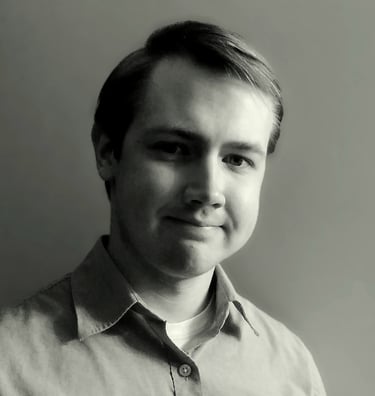
Philip Reim is a new author located in the Midwest, as well as a designer, violinist, and amateur painter.
Subscribe to FREE digital flip copy of the Adelaide Magazine printed edition.