THE PRESCRIBER
ALM No.87, March 2026
SHORT STORIES


Since Ahad completed his military service and left the garrison there was no other solider to fill his position in the clinic. They were desperately searching for someone who was acquainted with medications and treatment. The village of Gourab was not a long way from the city of Dehloran, but the problem was the ambulance that took too long to start.
Actually it was not a garrison but an operational area, located about eight miles from the border of Iraq, in a barren desert, where only our battalion was stationed. There were about twelve bunkers, some ammunition storage containers and barbed wire fences of about two feet high set out all around marking the boundary of the military zone.
On the night of my arrival, Fatemi, the First Lieutenant and the company commander, came into the bunker and called me outside. He asked me:
- Have you studied veterinary medicine?
- No, animal science.
- Have you ever given injections?
- To cattle and sheep, yeah.
Fatemi was from Ghir, a village that was a part of the city of Firozabad, but as it was closer to the city of Jahrom, people would go there to visit a doctor and get medication.
He asked, “How are the two Doctor Kazemyans related to you?”
I said, “The one whose office is at the top of Mosalla Street is my father and the one in Baharestan Street is my uncle.
He said, “Say the same thing to the colonel when we meet him. Tell him you were your father’s nurse’s aide.
He then said, “Next time, when you are home on leave, ask your father to fill a few unnamed prescriptions and buy an air conditioner for the officers’ bunker.
I said, “I am not on speaking terms with my father!”
“But you have the guts! “ Said he, “I just need a few sheets of prescriptions bearing your father’s stamp! By the way, I didn’t ask you to buy a Mercedes Benz! Don’t be so miserly with your money! “
I always had about a dozen of pre-stamped prescription sheets with me, to write the medicine I needed on, but never was I willing to pay bribes to get favors from the regular staff. I knew how to fill prescriptions. I first looked for the Latin spelling of their name in the medicine cabinet or box, where at least one item of any type of medicines could be found. Before the name of the medicine, if it was a pill, I would write «Tab», if a syrup «Syr» and if an ampoule «Amp». Then under the name I would write down the instructions in Persian. I was careful not to select drugs that were incompatible with each other so the pharmacy technician would not become suspicious. On such occasions I would ask my father, telling him that my friend called and asked me if the so-and- so drugs could be used together! And this was the only conversation exchanged between us.
I never took my prescription to pharmacies in the town of Jahrom because they knew my father’s signature. Once a week I went to Shiraz and got my medicine from the chemist’s in Vali-e-Asr Square. Earlier, I used to take tramadol, but later when the TV news began to inform people about its drawbacks and it was revealed why some people consumed it, and consequently it became difficult to purchase it from drugstores I started to take diphenoxylate. And whenever I had a sleepless night or was inspired to be more disciplined and get up on time, I would get clonazepam to help regulate my sleep schedule. When I missed someone or failed to remember something, a diazepam injection would come to my help, followed by some cups of tea. Over the first half an hour I would feel so drowsy that I could hardly keep my eyes open, but then I would begin to fall into hallucinations and see the moments I had forgotten before my eyes like an old black and white movie. It would make me float up in the air and then take me with the one who I loved into a spherical chamber, something like a toughened glass bubble.
On the days I was suffering from anxiety I would take chlordiazepoxide, and when my tics flared up haloperidol. Once a year, I had a burst of nervous tics and had to take haloperidol for a few months. To get my other medications no prescription was necessary.
That was the whole thing that I had received from my father as a physician. He was not that type who cared about saving money. He would whether pay his money for his religious obligations or give it to my mother who could not wait to go through it before noon: she would spend it to buy gifts for friends and acquaintances, meat for the old woman who used to sit in the street corner, and give some to the blond Afghan girl whom she had met in the market. And at noon she would call and say, “I have no money to pay for the taxi to drive me home! Come and pick me up!” Nothing of that money would be left for us the kids. We had to keep up appearances, pretending to be well-off. After so many years, we had just a modest house and an ordinary car. My father used to say, “You can stay here in this house for as long as you wish and enjoy yourself. But if you ever decide to live on your own, you should rely on your efforts to make money and pull yourself up.”
I did many types of work, from marketing food, selling tickets and trading fruits to applying artificial insemination to cattle and dismantling scrap cars. I never mentioned what my father did for a living otherwise my salary would be slashed. They wondered why I should ever have tried to earn money when I had such a father! I did not work in Jahrom so the people would not gossip, “The son of such a father is having such a job!”
When the colonel gave his consent, if I was allowed, I would have danced and capered around the room in an ecstasy. But I hid my enthusiasm and just said, “You’ve been most kind, sir.”
Everyone told me, “From now on, you will be rolling in the comfort. Say goodbye to militarism and hello to a life of eating and sleeping.”
The clinic was a neat bunker with painted walls. Yet it hardly looked like a real bunker but a snug room with a private bathroom, a large water tank, a metal bed and a coat-stand. I would wear a gown instead of a tunic and slippers rather than boots. I was exempt from morning routine and the only solider who was allowed to stay awake after lights-out and keep the lights on. That would not only make them more grateful to me but under the pretext of being on duty I would sit revising the final volume of Café Crème in preparation for the exam, which I was going to take next time, when I went home on leave, to get my degree in French.
But the main part of this heaven was something quite different: I was placed in the centre of a medicine store. As my father used to say, “A camel in charge of the cottonseed warehouse!” The clinic had a shabby bed, rickety old room divider and an IV stand. It also had a window looking out that was covered in plastic sheeting rather than glass. The building was in the shape of an L, at the base of which the pharmacy was located. There were about fifteen medicine cabinets all covered in dust, and a resuscitation box as well as a first aid box. An ambulance was parked in the clinic’s backyard.
We had no doctor. They told me, “You are temporarily here and that they never send a doctor for a battalion with just two hundred soldiers!” The medical staff consisted of only two nurse’s aides. Sergeant Major Karami was in charge of the clinic for fifteen days and for the other fifteen Sergeant Mobaraki. Karami acted as if he was the owner of the medicine store: he didn’t let even one single tablet of acetaminophen go out of the pharmacy. He repeatedly said, “Soldiers feign illness!”
But it was my happy day when Mobaraki took command. He would simply leave me in charge of the clinic and go into the bunker to take a nap. He said, “Beware! If the colonel turns up tell him I have gone to inspect the sanitary conditions of the bunkers and water tankers then lose no time to come and wake me up.”
I had to seize this opportunity to prove my merit. On the first day, I provided a full list of all the medicines available, which were about one hundred. I knew about thirty of them only. Then I thrust a ten-toman note into Mobaraki’s hand and took his mobile phone. I called my father and asked him about the use of the other medicines. I ticked the ones that were dangerous or had severe side-effects. I also marked the ones harmful for patients with favism, those who have to avoid eating broad beans, so that I would remember not to give it to poor Hoshyar who had done what it took to be exempted from military service. He would come to me whenever he needed to get things off his chest.
The soldiers who came to the clinic in the morning would fake illness, whether to stay off training or maneuvering or they were hungry and wanted to get something filling to eat like sweet cream-filled cookies from the snack bar opposite the clinic. As they usually made out they had diarrhea or a toothache I usually kept some sheets of iodoquinol and mefenamic tablets somewhere at hand and when they turned up I would remove a tablet from the blister sheet and place it onto their palm so they could show it to their commander and avoid being punished. But soldiers, who came to the clinic in the afternoon, were really sick. They were those who would cut down on their soccer or sleeping hours to carry out their duties, and I would go out of my way to help them. I would give them half a sheet of tablets and, if necessary, an injection and IV solution. And if the treatment was not effective, I would fill in the dispatch form and transfer them to the health centre in Dehloran.
It was the second week of my work when Fares, one of the Arab soldiers, came to the clinic. He had stepped on a piece of glass on the open, dusty land where we played soccer in the evening. A shred of glass had stuck into his sole-skin. He used to play barefoot and was famous for his Zidane-like dribbles. That day it was Mobaraki’s turn to attend to the patients and the moment his eyes fell upon Fares’ dirty and bloody injury, he said nervously, "I won’t touch this! Fill out a dispatch form for him!”
Fares said, "How can I ever afford a visit to the hospital? Leave it. It will get healed by itself.”
So I rolled up my sleeves and got on with it. I had seen suturing but never tried it once. I called my father and told him that the nurse’s aide wanted to stitch up a cut on a soldier’s sole, and he told me to use zero silk sutures. I washed Fares’ foot with distilled water, cleansed the wound with a piece of sterile gauze, dripped a few drops of iodine onto the wound and gently scraped the area around it with a scalpel blade. Then I gave two cc of lidocaine 2% to numb his foot. I brought the two sides of the cut together. As I did not know how to use forceps and dressing forceps, I used my hands to do the surgery. It was like sewing a patchwork ball: I inserted the surgical needle from one side and pull it out from the other side. Then I tied the two ends and snipped the suture thread. I did the same thing again with an interval of about two inches. Fares got four stitches. I bandaged his foot and handed him two sheets of cephalexin pills and pleaded, "For the sake of your mother take one every six hours otherwise it will get infected and we will be in big trouble!”
Soon the rumor spread in the garrison that I seemed to be a doctor, good enough and had kept this hidden. A few days later I stitched an eyebrow and a finger of two other people. I became the staff’s favorite. No one would care for the nurse’s aides any more. Whenever a member of the staff was sick, they would sent for me and I would go into their bunker giving them an injection or a tablet, then I would eat the fruit or drink the fruit juice they offered me. And if the colonel was away on leave, leaving Major in charge of the battalion, their hookah was also lit. I would then make a short pause and take some puffs. “Don’t worry! Relax!” They said, “You are not a stranger any more.”
It was also me who would give Major his dicyclomine injection. He constantly complained of pain in his kidney. He warned me, “I have put my trust in you so I should never hear you have told anyone in the battalion about me!”
The soldiers told me, “No one dares to interfere in your affairs as you have visited everyone here and now you know about them all.” I had reached the safety point. I was also given the task of preparing and sending the invoice for the consumed items. Whoever came to me for treatment, I would give him half a sheet of the tablet he needed and kept the other half for myself, but in the register book I would record, “Soldier X, one sheet.”
Then I began to test the medicines on myself one by one. Each induced a different pleasant state in me.
The injection of metoclopramide would make my neck stiff, and erase my memory. Yet if I took three tablets of it, I would feel like my head was filled with straw than brain, but its drops had lighter side-effects.
Expectorant-codeine cough syrup would work well if I took the recommended dose but my head would then feel terribly heavy. It would give me the feeling that I was punished and now had to carry a rhino’s head instead of mine.
At times I took different medicines together. For example, taking dexamethasone tablets together with diphenhydramine syrup helped me withdraw from the previous medicines, but it gave me hiccups that I had to endure. Diphenhydramine generally has a good combination property like London rocket seed that has different healing properties and can be used by anyone with any type of illness. But some medicines have dominant effect: no matter what medicine is taken before and after them, they produce their own effect. Some medicines have an excellent property to prepare us to take other medicines. For example diphenoxylate has sedative effect that puts you in a soothing state before you decide what medicine you want to take next. At the same time it won’t let the second medicine have a too weak or too strong effect on you. It is like a piece soft music that you feel its presence only when it is interrupted, but if it is switched off you will feel whether fed up or too nervous. Some medicines act as seasoning: they raise the quality and make the taste more appealing. It is more like cooking: cooking for soul and spirit. Then I learnt how to dream when I was awake.
However, with the arrival of heat season, I lost my peace and tranquility. I became very busy and completely snowed under with work. I wrote a letter to Colonel and requested for Hoshyar to be transferred temporarily from the Infantry Company to the clinic. He was diligent and obedient. Yet it took only one week when he showed his true color and I discovered things about him that he had kept them hidden from me all that time. It was like he had achieved his ambition: an ideal position in a warm and cozy room that now he wanted to abuse. I found out that he had lied to me about his favism. He had two older brothers: one was a eulogist and the other in jail. One day while he was twirling a chain around his finger he went to tease the newly-joined soldiers. He used to hit them on their nose with his head and then go flatter them so they would not go complain or tell others.
At times, while listening to a eulogy Hoshyar would repeatedly pound his head on the wall or the floor. Every day his mother called Mobaraki on his cell phone and asked him to let her talk to me. She demanded me to take care of Hoshyar, “God knows that we are also wondering about him! None in the family behaves like that! Please be patient with him. There is only his brother who is in prison, but that’s only because his friends stabbed someone and put the blame on him.”
I really ached to cut a piece of meat or pluck a bone from his body and stitch it onto his forehead so that he would turn into a horned bull or a unicorn horse and could bang his head harder on the walls. However, I let him stay just because the driver was on leave and I had entrusted the ambulance to him and also given him the duty to search the garrison for scorpions. He killed thirty to forty scorpions a day. Giant scorpions! Some were as long as my palm! The majority were black and a few yellow. There were seven or eight cases of scorpion stings daily. To give them hydrocortisone and chlorpheniramine injection intravenously, I had to be very good and quick at venepuncture. As soon as I finished with one vein I moved to the next one. Oh, I felt miserable when the patient was dark-skinned, coming from the south or an obese Arab who you could call Potato: no single thread of a vein you could find! In these cases I first had to take one of my mixtures to help me collect all my concentration and then I began feeling for the vein over the front of their forearm, from the wrist to the elbow, until I could possibly find a narrow one.
The hopheads also began chasing the scorpions. They would dry the tail and give the trunk to me, which I kept in my old deodorant bottles filled with alcohol. However, I did not keep just any scorpion: its appearance should have appealed to me or it was different from the ones I had collected. I said to myself, “By the end of the summer I will have possessed a collection of scorpions that I can show to anyone when I leave the army.”
Some would make a ring of fire and then toss the scorpion onto the ground into the middle of the circle where it began turning around itself. It would keep twirling around itself until it stung itself to death. But when they did not sting themselves, they would be thrown into the middle of the fire where they curled up and twisted and then caught fire and slowly charred to blackened ash. Moments later thick black smoke would spiral up into the air.
My tics appeared and I felt great urge to touch the flames. The same tics I used to experience once a year, when I came across a scene that gave me the shivers. At fifteen, I developed shoulder- shrugging tic, after the high school kids broke the old quilter’s shoulder with a stick. When I was sixteen, I began to smell whatever I hold in my hand, after Reza’s nose was smashed up in a car accident. At the age of seventeen, I would kiss my nails, one by one, and this happened after the neighboring boys, having taken a retarded girl away, had painted her nails and when she returned home, his brother pulled her nails out! All her nails!
My tics appeared again and I felt great urge to touch the flames. I felt like to be surrounded by fire and keep swirling around and around myself. Twirling around myself I would pass my hand through the flames and keep on spinning my head from side to side. There was no haloperidol available in the clinic, so I went into the bunker and sat combining different drugs into a new cocktail.
Early in the evening the secretary informed me that I was the duty officer that night. My name, as the duty officer, would appear on the roster just once a month and that was mainly because no one would raise an objection. The privates were hardly allowed to hold the post of the duty officer except on Friday nights. I told him, “You should have informed me in the morning when I was conducting inspections of the guards, not now! By the way, I have no idea who the guards are now and in case there is a new soldier I have to give him the initial instruction too.” The secretary said, “You know Rahmani, the engineer, has got a scorpion sting, not feeling well at all and we have to replace him.”
Hoshyar came to me and said, “Tonight I am your guard too, on the second watch of the night, but I want you to change it to the first, because on the second watch I become a nervous wreck. Neither can I sleep from nine to twelve nor am I able to sleep from three to six!” I said, “Tonight you will have to stay up together with me until morning so that you can immediately come to inform me if someone comes to the clinic. Mobaraki is carefree, and will sleep with no care in the world. The only thing I can do for you is to change your post from a petrol guard to a guard for the clinic.”
- You mean there is no other way?!
- Even if God comes down!
- You know I take depressants.
- You want to trick a trickster!
I was not so strict. Even if the guards slept on duty I would hardly get tough with them. But now I was itching to get on Hoshyar’s nerves, as I had heard he would get the petrol out of the ambulance and wishing to ingratiate himself he would give it to those staff who commuted to work by the company car, lived in corporate housing in the city of Shoshtar and at weekends went home to be with their family.
He said, “You will regret it!”
I growled, “Are you threatening your superior?! Ok, you will be the same patrol guard tonight and if you ever disobey I will throw you in the back of the ambulance and keep you locked in until morning.”
The day after was holiday and I had indulged myself too much. I had a special food-for-soul followed by an injection of diazepam and then I drank three or four glasses of tea. After a little while I began to have illusions. I did not want anyone to get on my nerves. Whenever I was in such a mood I would snap at anyone who disturbed me even if she was my beloved.
I changed into my military uniform, put two cigarettes into the pocket of my tunic and set off toward the courtyard. The guards were at their post. I greeted them all warmly one by one and warned them to be very careful as the security officer was possibly coming for inspection that night. Then I went behind the mound, smoked my cigarette and went back into the bunker.
Hoshyar was sitting in the corner of the bunker, retreating into himself. He was neither twirling his chain around his finger nor listening to eulogy. His head was lowered. I asked him," Have you taken your pills?" He did not reply. He got up and went into the backyard, lifted up the hood of the ambulance and stood fiddling with it.
I started having tics again. There was no flame available. I closed the door and put an unlit cigarette between my lips. My mouth was dry and I was wrapped up in pleasant reveries which were floating in the air, gliding up and down and fooling around.
The door opened and Hoshyar stepped in, carrying a water can. As soon as his eyes fell upon me he fixed me with a stare. He then began to pace the bunker up and down, mumbling something quietly. He was not eulogizing but as if bragging. "Have you taken your pills?” I asked him again.
He turned back, and gave himself a sharp slap on the forehead with his hand. He was shaking his head from side to side with his eyes rolling around in their sockets. His eyes were blood red, as if they were raining fire. He stood staring at me again. He came close and closer and suddenly let out a yell. He lifted up the water can and then turned it upside down over my head. It was not water and it was not hot! But I at once grew burning hot! I was wondering what suddenly happened! I had just been trying to light my cigarette or perhaps he had offered me a lighter, having noticed an unlit cigarette dangling from my lips and I had been looking for a match in my pocket.
I began dancing. I swayed. I did not feel a feverish heat running through my body. I was not burning the way I desired yet I kept on dancing, swirling around myself and inside myself. I touched the fire and my body. The fire was clawing at me and the whole of my existence. It had taken hold of my hand and we were twirling around together. It was going beyond me. It was growing larger, disintegrating my body in the air and taking the fragments away with itself. My clothes were getting torn in shreds and scattered. My flesh was breaking up into fragments detaching from my body. With each piece leaving my body I would feel light and lighter. I was moving away from the earth.
There was a noise followed by a clamor. I heard some people saying, "Put him in the ambulance." But the ambulance was broken down! What wrong had I done that they wanted to lock me in the ambulance? It was not me! It was not me who was screaming. I had just raised my arms up to fly. How come did the soldiers suddenly appear? Why were they holding my legs so firmly not letting me ascend into the air? They put a blanket over me whether to suffocate me or to play a blanket game with me?! Then they rolled me inside the blanket and hold me tightly from two sides. I was gasping for breath under the blanket and I could hardly see anything. I felt as if something like a toy plane would go inside my body through my toes and move toward my head where it would leave my body and return to my feet again. My pain would increase only when it crept through my chest toward my neck. I began to rise from the ground floor, gently and inch by inch. Then I moved into a closed area: something like a spaceship with iron walls all except one which was glass. I lay down and felt weightless. Weightless! It was like the feeling you have when you are absolutely exhausted and run-down and someone will come and give you a good massage, and finally, to make your shoulders relax, he pulls your shoulder blades together, make them crack, and you will hear the sound of CCCCRRRRUUUUNNNNCCCHHH!!! Someone came and sat down beside me and took hold of my hand. I said, “Let’s go out for a change. I feel hot and fancy a frappe.”
- Take a gulp of this!
The ambulance started up, but would die immediately. The jerks rocked us like a cradle. I pushed my eyes open. It was Mobaraki who raised the glass of water to my mouth. He placed his hands on my back and said softly, “Take a gulp of this water.”
He then took out his cell phone, dialed my father’s number and held the mobile close to my mouth and said “Tell him what medicine you have taken.”
I heard someone repeating “Hello hello” on the phone but I could barely utter something. He took back his cell phone. I could hear my father's voice, shouting:
- Is this woman having hot flashes in her menopause period? If so you should give her estrogen or five-finger plant!
The line kept on breaking up. I heard few words clearly but then the voice would gradually trail off. It seemed he was guffawing. I opened up my five fingers and kissed them one by one.
- In his pocket we’ve found some effexor pills with some other discolored pills. His blood pressure is at 19 and his face is flushing red.
- Who is this poor person who has taken all these medicines?! Give him diuretics. It will do him good.
- What? I said he is your son! What on earth is a menopausal woman doing here?! Whatever is diuretics?! I am sergeant Mobaraki!
- My Father was almost yelling, “ Diuretics! Diuretics! He will be fine soon after he passes water!
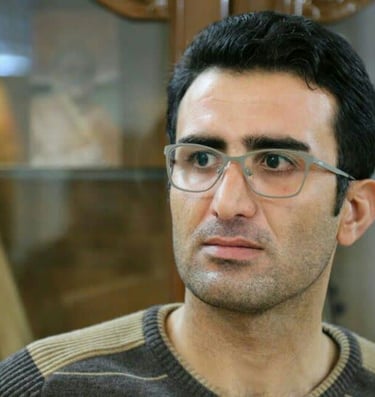
Abouzar Ghasemian (b. 1984, Iran) is an emerging Iranian writer. His first book, Lip Reading, was published in Persian by Negah Publishing House and received critical acclaim. His short stories have won several Iranian literary awards, including the Mehregan Literary Award, Tabriz Literary Award, and Bahram Sadeghi Literary Award. His story “The Prescriber” has been translated into English by Sajedeh Asna’ashari.
Subscribe to FREE digital flip copy of the Adelaide Magazine printed edition.