THE WINDOW
ALM 92, August 2026
ESSAYS
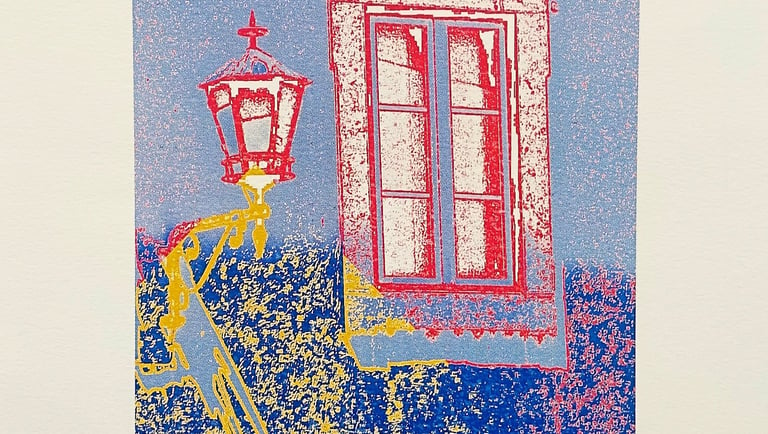
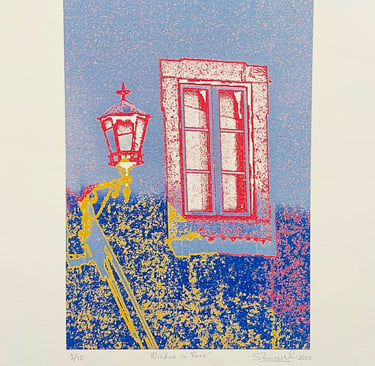
There are things we notice only when we are afraid of losing them.
I noticed the window. Always — this window. Still on the street, still half a block away, when my sneakers tap something resembling impatience against the asphalt, I am already searching for it with my eyes. Second floor, first on the left. And she — in the opening, leaning on the white windowsill, as though she has been standing there for a long time. As though she always stood there. As though the window without her is not a window at all, but simply a hole in the wall.
She greets me. Every time.
Philosophers have written much about time. Augustine struggled with the question: what is time, if the past no longer exists, the future has not yet arrived, and the present is merely an elusive boundary between them? But I think Augustine never saw an older woman in glasses standing at a window among flowers, waiting for you to turn the corner. Otherwise, he would have known time is exactly this. Time is waiting for another person. Time is love, stretched between two points in space.
There is a great difference in age between us. People sometimes wonder — what can connect two friends whose lives are separated by decades? But those who wonder simply do not understand what it means to share a language in the most literal sense. We have one — English, which we both teach, which we both breathe. She teaches it to children in school; I teach it to students in a lecture hall. Different audiences, the same impulse: to place something living inside another person, something that will remain there forever. We sit at the same table and devise grammar tests, quizzes, assignments. We argue about methods. We laugh. We cook soup together at her place and help each other with the laundry, and in this perfect ordinariness there is something so genuine that the word "happiness" feels too small.
Heidegger said that authentic existence begins when a person becomes aware of finitude. I would rather not agree with him — it sounds too cold. But I understand what he meant. I understand it precisely at this window.
I know — and this knowledge lives in me quietly, like a seed beneath the snow — that one day I will walk down this street and look up, and the window will be empty. The flowers will perhaps remain. The white frame will remain. The sky in the glass will remain — that pink evening sky she loves so much. But she will not be there. The one who leaned on the windowsill and looked down with mild concern: "Well, finally — where have you been?"
And this — the empty window — I already carry within me. Alongside the living, real, warm one. This is the strange gift of awareness: to see a person and simultaneously see their absence. To love and already grieve in advance. Not because one wishes to grieve — but because one loves truly, and true love always knows more about time than we would like.
But here is what I have come to understand. The empty window of the future does not cancel the living window of the present. On the contrary — it makes it unbearably beautiful. Each time I see her there — in the soft light of the lamp hanging from its chain, among the purple and red flowers — I see it with double vision: both what is, and what will one day no longer be. And from this, the heart contracts in a particular way — not from pain, but from fullness. Too much all at once. Too alive.
There is a Russian word — провожать — that has no precise English equivalent. In other languages it is conveyed descriptively: "to see someone off," accompanier. But in Russian it is something special: in it one hears the road, and care, and something resembling a blessing. She sees me off from the window. I leave — she watches after me. I do not see that gaze, but I feel it in my back, like warmth.
A teacher is one who accompanies. In Greek, "pedagogue" literally means "one who leads the child." But we both know that in true pedagogy there is no single direction. The student leads the teacher just as the teacher leads the student. And she has led me — silently, from the window, through her presence, through her care and devotion, which never demanded explanations and never asked for anything in return.
Philosophy has long been asked: what is the meaning of life? And long answered differently: in knowledge, in virtue, in pleasure, in service. I make no claim to a universal answer. But I know my own. The meaning lies in this: returning home, lifting one's eyes, and seeing in the window a person who cares whether you have come or not.
The meaning is in the window where she stands.
And when this window is gone — and it will be gone, for time will claim what is its own, as it always does — I will carry it with me. I will carry it within me like a lantern. Because everything we love and lose does not disappear — it becomes part of our inner light. The light by which we illuminate others.
I will stand at my own window.
And watch after her.
Dedicated to her — the one who is always at the window.
Prof. Victoria Akopova is a writer and independent researcher with a passion for exploring the human mind through both science and literature. Her work combines psychological insight with a deep interest in language, memory, empathy, and personal transformation. Whether writing scholarly articles or personal essays, she is drawn to stories that reveal the resilience of the human spirit and the power of words to heal, connect, and inspire.


Subscribe to FREE digital flip copy of the Adelaide Magazine printed edition.