THOUGHTS OUT OF SEASON: MARATHON, MAGA, AND ME
ALM No.91, July 2026
ESSAYS


There is a stubborn torch that flames from Marathon to Concord — Robinson Jeffers, “Shine, Republic”
In January 1976, I stood gazing up to an ancient, grassy burial mound rising forty-feet above the plain of Marathon. The tumulus, or soros, contained the remains of the Athenian soldiers who died at the legendary Battle of Marathon in 490 BCE. I was a twenty-five-year-old American backpacking through Europe; Greece loomed large on my itinerary. I walked that sunny Saturday from central Athens to Marathon in order to pay my respects to an idea.
In October 2023, during a month-long trip to Greece with my wife, I returned to the plain of Marathon as a husband, father, and grandfather.
The plain of Marathon is where the badly out-numbered Athenians, aided by their allies from Platea, repelled the Persian juggernaut; some 6,000 Persians and 192 Athenians died that day, according to Herodotus. Whatever the actual numbers, there is no question the victory over the Persians was a military miracle that helped launch the Athenian golden age of self-governance — the north star our founding fathers steered by.
“The watchword was freedom; the stake was the independence or the enslavement of Greece,” Edith Hamilton wrote in her iconic The Greek Way of the Battle of Marathon.
When I stood before the tumulus all those years ago, I was uncertain of myself, and of my future, let alone my ability to earn my keep with a pen. I wondered, at times, about my sanity; I had tossed and turned through more than a few vertiginous, dark nights of the soul. And yet, in 1976, at least the bow of America’s ship of state seemed to point up. We had come through Watergate; the war in Vietnam was over, however ignominious its ending; the decent, refreshingly unexciting Gerald Ford lived in the White House. And we had the great comfort of knowing who our enemy was: the Soviet Union.
***
On my 2023 pilgrimage to Marathon, I arrived bearing a shadow of grief: the enemy, it turned out, was us. The MAGA cult, powered by social and right-wing media, was on the march at home, as were authoritarian movements in Europe. Russian aggression in Ukraine couldn’t have made the stakes plainer.
One of our two major political parties has stood squarely behind the man who tried to overthrow the 2020 presidential election results; a man-child grifter who can’t tell the truth about what time he ate breakfast. “We had fed the heart on fantasies, The heart’s grown brutal from the fare…” as William Butler Yeats wrote of a different, and not so different, era.
And we have elected that man a second time. We’re caught in some kind of nightmare of history from which we can’t awaken, a history I once thought assured stability and domestic tranquility as our birthright. A history whose arc, however imperfect, bent toward justice, from ancient Athens through Concord to our own time.
***
“A populace deprived of the ability to separate lies from truth, that has become hostage to the fictional semblance of reality…is no longer capable of sustaining a free society,” wrote Christopher Hedges in Empire of Illusion: The End of Literacy and the Triumph of Spectacle. Published in 2009, before the rise of Trumpism, Hedges’ book caught the scent of a Trumpian specter riding an ill wind a half-dozen years before the man himself came riding down an escalator.
“At no period in American history has our democracy been in such peril or the possibilities of totalitarianism as real,” Hedges wrote. “Will we heed those who are sober and rational…or will we follow the demagogues and charlatans who rise up in moments of crisis and panic to offer fantastic visions of escape?”
Let us not forget to add to the mix the adolescent thrill of performative transgression, of the “monetization” (the right word for our age) of breaking things. These are hard days for those who still have nightmares about junior high school. The entire mess reminds me of a photo in an old book about World War I: above the door to a ruined Belgian chapel hung a wooden sign in German: Don’t be angry. Just admire.
***
Saint Paul urged us, upon reaching adulthood, to “put away the things of a child.” I had thought, once upon a time, only children get to create their own reality. When Andre Malraux asked an old Catholic priest what he’d learned about human nature, after hearing numberless confessions, the reply was: people are unhappier than you’d think. And, “There are no grownups.”
***
My father fought in some of the worst battles of World War II in France and Germany in 1944-45, the coldest European winter in a century. On my European travels in 1975-76, which I had paid for by working a night job as a janitor at a toney athletic club in downtown Seattle, mopping floors and cleaning toilets, I felt duty-bound to visit several American military cemeteries in Europe. My detours included the Normandy American Cemetery above Omaha Beach; the ranks of white marble crosses and Jewish markers, almost 10,000 of them, broke my callow heart. The Normandy landing beaches, like Marathon, mark the place where the concept of self-government and the rule of law prevailed against the dark.
***
“The flowering of genius in Greece was due to the immense impetus given when clarity and power of thought was added to great spiritual force,” Hamilton noted in The Greek Way, first published in 1930. “It made the Athenians lovers of fact and beauty.” Fact and beauty, in our country and in Europe, are now under assault, when they’re not considered simply passé.
Hamilton, looking through the ancient Greek lens to the world of 1930, put her finger on what ails us in 2026: “We are buried with over-realization. Not that we can perceive too clearly the rights and wrongs of every human being but that we feel too deeply our own, to find in the end that what has meaning only for each one alone has no real meaning at all.” Such narcissistic nihilism leads to selfies at Auschwitz. Hannah Arendt wrote of the “banality of evil.” In our time we are experiencing the evil of banality.
This is a considerable distance from the ancient Greek concept of sophrosyne — self-mastery, discipline, self-control, even decorum, as the basis of freedom and rule of law. Sophrosyne looked down upon base self-assertion and arrogance, and would never allow a citizen to take cover behind the First Amendment in defense of a lie.
***
I don’t want to be an elitist. I don’t think everything would be ducky if we all just read Proust. I don’t place myself above anyone, I’m just off to the side with those others who respect the fact that life is complex, and who pay attention to the life of the mind and soul. That’s all. I grew up in the Catholic Church. I learned, through the philosophy of Saint Thomas Aquinas, to keep an eye out for not just my own best thoughts but the best that has been thought throughout history.
This is our precious inheritance, the pearl beyond price or monetization.
***
Was it Hannah Arendt who wrote that those who will believe anything will do anything? If so, history backs her up. Being part of the MAGA cult means never having to say you’re sorry. Or ever admit you’re wrong. Quite the contrary. “Doubling down” is the operating euphemism, which euthanizes any chance of meaningful debate. Our current mess isn’t about a clash of ideas, or political vision, but about revenge, resentment, and imperious entitlement. I say this not as an aging, card-carrying leftish Boomer, but as one who saw through those of my generation in the Sixties, all shook up by the sins of Richard Nixon, who were insensible to the monstrous reign of Chairman Mao or the crimes of a homicidal maniac like Joseph Stalin.
***
I live in a small town on Puget Sound, northwest of Seattle. It’s a nice place. We have a Post Office, a country store, and a long wooden pier which serves, on summer evenings, as the community promenade. East, across the water, the Cascade mountains rise behind Seattle’s steel and glass towers; the snow-cold heights of Mount Rainier loom surreally to the southeast. The rugged Olympic range stands sentinel in the west. The little reservation town of Suquamish, home of the Suquamish tribe and burial place of Chief Seattle, lies just down the bay.
The community leans deep blue. That fact, too, carries its own orthodoxies and occasional silliness, but I don’t find myself thinking about what kind of weaponry and ordnance my blue neighbors have stockpiled. I can abide the occasional drum circle or granola breath.
If things get hot, if civil order ever breaks down, I do wonder who in our community might turn. I mean those people who would believe anything: the man who’d give the shirt off his back to anyone in need, of any skin color, who works in his yard proudly wearing his “Let’s Go Brandon” T-shirt. Or the fellow I once coached in youth baseball, now a still-polite, smiling family man who grew up in a house-hold where Rush Limbaugh was a demi-god.
Surely not.
Then I think of Ireland during the Troubles, or Spain in the Civil War, or the former Yugoslavia in the 1990s. Neighbor turning on neighbor is an inexhaustible chapter in the world’s story. I don’t want to think about my neighbors this way.
I already have.
***
Why would the Republican party honor any result other than victory in the 2028 presidential election? After all the banked anger and promiscuous lies, why would they? Their movement has no brakes, no reverse gear. Truth has constraints, falsehood none. Democracy requires an ability to hold two, or more, ideas in one’s head at the same time. Why bother when you can “double down” and dance to a one-lane-brain-music?
***
“Is there hope?” a friend, besieged by a rare form of cancer, asked me in the early winter of 2018. This was over a farewell lunch with her and her husband ten days before she died. Her husband was a highly regarded university professor; she was a gardener and garden writer. They were inveterate, deeply informed world travelers and bright conversationalists. Trumpism hung like a crude blade over everything she held dear.
“Yes,” I answered, fingers half-crossed in my mind.
I told her of our two sons, and their friends, and how the those thirty-something “kids” were doing admirable things in the world — among them were artists, non-profit lawyers, conservationists, woodworkers, boat builders — a grounded, competent cohort who would be handy in a shipwreck and felt at home on the dance floor.
I realized that her question was about more than hope. It was rooted in a prayer for the continuity of humankind’s best thoughts and creations. The Greek concept is arete —excellence, and its pursuit.
Her husband played her favorite music as she died at home. Her last breath came during Elizabethan composer William Byrd’s Sanctus, from the Mass for 4 Voices.
***
In May 2017 I visited one of my father’s old battlefields in Alsace. On a freezing night in January 1945, American soldiers under heavy fire approached the small village of Jebsheim. It was so cold that when a mill caught fire outside of town, many of the American boys gathered near the flames even though they made themselves visible to the Germans shooting at them from the village. After the GI’s liberated Jebsheim, they moved on to the next village they’d never heard of.
There is a peace pyramid at the site of the burning mill now, inscribed with messages of comity in French, English and German. In a nearby hedge, I buried a copy of my father’s discharge papers and whispered a few words. Later, in town, I came upon the modest street named after my father’s 1st Battalion, which was part of the 254th U.S. Infantry Regiment. They were the first into Jebsheim, which has been described as a slaughterhouse.
A crew-cut man in his 40s with an amiable face watched my wife take a picture of the 1st Battalion street sign. I walked over to him; he didn’t speak English. “My father was here,” I said in French, and smiled, pointing to the sign.
Across the centuries, some mutual regard flowing from Marathon 2,500 years ago to the liberation of Jebsheim in early 1945 passed between us. I won’t forget, ever, the flash of sincerity in his dark eyes, and the lingering firmness of his handshake.
***
Life, though, is rarely so clean and simple.
This is the dilemma for people like me, and probably you, who do not want to draw battle lines among neighbors, or distant strangers; who want to operate with respect for life’s complexity without reducing anyone on the other side of the political, or existential divide to the proverbial “other.”
In May 2025 I returned to Omaha Beach with my wife. In September 1975 I had walked there from the lovely Normandy town of Bayeux, pack on my back. I left in late afternoon; the last of the sun turned the flat landscape to gold as I walked the poplar-lined road, the slow, sweetly beautiful piano notes of Erik Satie’s Trois Gymnopédies —such a clichéd internal soundtrack — playing in my head.
I spent the night in a cheap hotel in Port-en-Bessin-Huppain, about six miles from the Normandy American Cemetery and Omaha Beach. I remembered the village as a blue-collar harbor with no pretensions to glamour. This time I returned to Normandy by rental car. We stopped in Port-en-Bessin-Huppain for coffee before moving on to the cemetery. The modest village had the same unpretentious vibe. There’s an old saying about the areas around the landing beaches of Normandy: the French are extra hospitable to visitors hailing from the U.S., Canada and Great Britain.
In the café, I found it so. The early afternoon atmosphere was raucous and friendly. At the table next to us I noted an American in his early sixties: short, nondescript, with a Southern drawl. It was his red MAGA that got my attention. He sat with his wife and a tall Frenchman in his early forties who was clearly their guide for the day. The MAGA man and I exchanged glances; my glance might have been a glare.
Later, at the cemetery, I was moved all over again, as I had been fifty years before. Back then, my life lay before me and the world seemed stable. Now, I could make out the long road behind and the future, especially for our grandchildren, felt like a crapshoot.
The parking lot was packed with tour buses and cars; the crowded cemetery walkways were respectfully quiet. To be in that place, where American boys waded ashore to liberate Europe from the Nazi terror in the name of the rule of law, is humbling. The Normandy beaches may represent the summit of America’s moral high ground, a position my country was now actively abandoning.
On the way back to our car we encountered the MAGA man, his wife and guide. I exchanged looks of recognition with him. He smiled. I’m not sure why, exactly but I spoke: “Fifty years ago I came here alone with a pack on my back. My father wasn’t here in the War; he was in the worst of it in Alsace and across the Rhine. And here I am at Omaha Beach again. I never dreamed of being a grandfather back then.”
A strange thing to blurt out. I guess I was roiled by a mix of emotions.
The man took my hand, squeezed it firmly, looked me in the eye and said: “God bless you. God bless you.”
From some deep place, he meant it.
“Thank you,” I said. And meant it.
Tell me, how does this end?
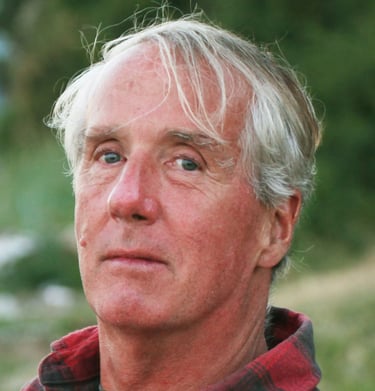
Mike Dillon lives in Puget Sound country in Washington State. His poems and essays appear in this country and internationally, including Kyoto Journal, The Galway Review, Adelaide Literary Magazine, Poetry Salzburg Review, the award-winning anthology Take a Stand: Art Against Hate, and numerous other venues in print and online. His most recent book is Nocturne: New and Selected Poems, from Unsolicited Press (2024).
Subscribe to FREE digital flip copy of the Adelaide Magazine printed edition.